
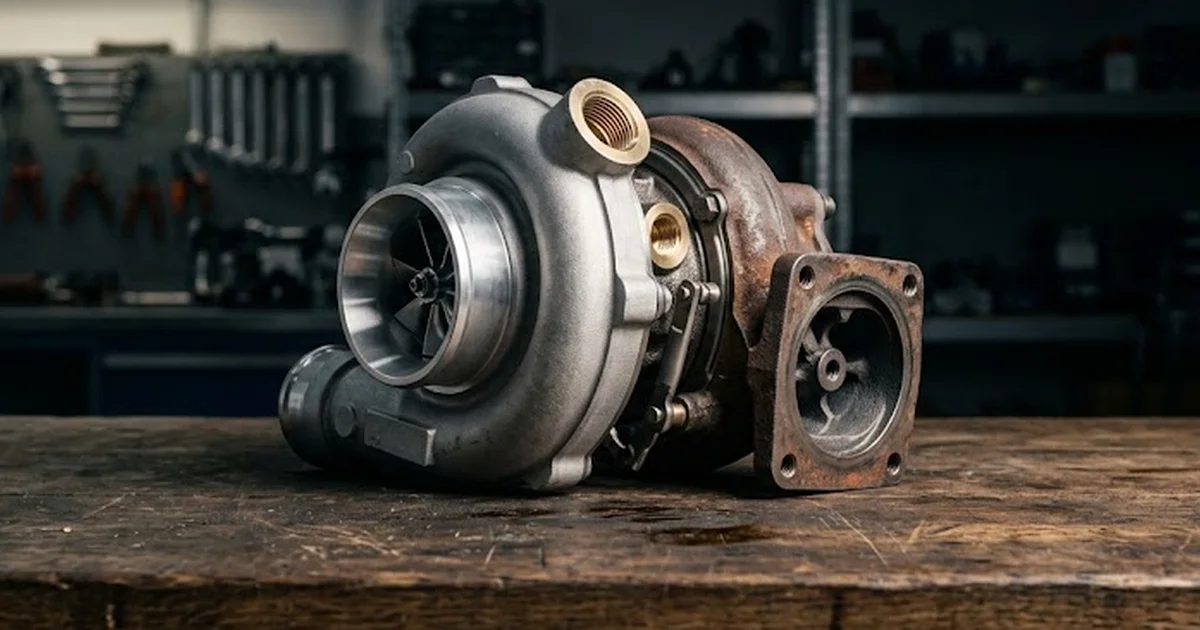
How much does a turbo cost to fix uk?
Wondering how much a turbo costs to fix in the UK? Explore realistic parts and labour pricing, diagnostic fees, and remanufactured exchange savings.
Average Turbo Repair Costs in the UK: Price Ranges and Repair Scenarios
When sudden boost loss, a high-pitched siren whine, or thick exhaust smoke signals that your turbocharger is compromised, understanding the financial reality of the repair is vital. In the UK, fixing a turbo is rarely a single fixed-price transaction. Depending on whether the issue lies in an external electronic actuator, an internal turbine bearing failure, or extensive oil contamination, total repair bills generally range from £250 for minor external adjustments up to £1,800 or more for comprehensive assembly replacements at franchised workshops. The final invoice combines diagnostic fees, precision components, necessary ancillary hardware, and workshop labour time.
The table below provides a realistic breakdown of typical turbo repair and replacement scenarios across UK independent garages and specialist workshops. These figures reflect market averages for standard passenger cars and light commercial vehicles, accounting for both component expenses and the professional workshop hours required to complete the work correctly.
| Repair Scenario | Component Cost (£) | Workshop Labour (£) | Ancillary Parts & Consumables (£) | Typical Total Invoice (£) |
|---|---|---|---|---|
| Electronic Wastegate Actuator Replacement | £120 – £260 | £90 – £180 | £20 – £40 | £230 – £480 |
| Boost Hose & Pressure Sensor Renewal | £45 – £130 | £70 – £140 | £15 – £30 | £130 – £300 |
| Remanufactured Standard Exchange Turbocharger | £280 – £580 | £240 – £520 | £90 – £160 | £610 – £1,260 |
| Brand-New Aftermarket Turbocharger Assembly | £550 – £950 | £240 – £520 | £90 – £160 | £880 – £1,630 |
| Franchised Main Dealer Original Assembly | £950 – £1,800 | £450 – £900 | £140 – £250 | £1,540 – £2,950 |
For the majority of UK motorists driving family hatchbacks, crossovers, or work vans, opting for a standard exchange remanufactured unit through a reputable independent garage typically settles between £650 and £1,100 all-inclusive. Choosing this route restores factory-grade boost pressure and mechanical durability without the substantial dealer markup.
Key Factors Influencing Turbo Repair and Replacement Costs
No two turbocharger replacements incur identical workshop invoices. The total expenditure depends heavily on your vehicle engineering, the architectural configuration of the engine bay, and the underlying mechanical failure mode. Understanding these cost drivers helps both vehicle owners and trade mechanics assess whether an initial quotation accurately reflects the required technical labour.
- Engine Bay Layout and Physical Accessibility: On compact hatchbacks with transverse four-cylinder engines (such as a 1.5 dCi or 1.6 TDI), access to the exhaust manifold and turbo mounting studs is relatively straightforward, requiring approximately 3 to 4 hours of labour. Conversely, on complex rear-wheel-drive saloons, four-wheel-drive platforms, or transverse V6 configurations, the turbocharger may be tucked tightly behind the subframe, steering rack, or exhaust transfer box. In extreme cases, the entire front subframe or engine block must be lowered, pushing labour requirements past 8 hours.
- Internal Architecture and Actuation Technology: Older wastegate turbochargers rely on basic mechanical diaphragms and fixed-geometry housings, making them economical to purchase and calibrate. Modern diesel and performance petrol engines use Variable Geometry Turbochargers (VGT/VNT) fitted with intricate internal vanes and digital stepper motor electronic actuators. These advanced systems demand precise electronic adaptation and higher-precision components, naturally raising parts costs.
- Root Cause of the Failure: A turbocharger does not operate in isolation; it shares the vehicle lubrication, induction, and exhaust streams. If the unit failed simply from high-mileage bearing fatigue, the replacement process remains contained. However, if failure resulted from severe oil starvation, carbon sludge build-up, or foreign debris impact, the repair bill rises significantly because the entire lubrication circuit must be flushed and ancillary pipework renewed to prevent instant repeat failure.
- Regional Labour Rates Across the UK: Garage pricing varies noticeably by location. Independent repairers in rural areas or northern regions may charge between £60 and £80 per hour, whereas urban facilities, London-based workshops, and franchised main dealers frequently charge between £120 and £190 per hour plus VAT.
Parts vs Labour: How UK Garages Calculate Your Final Quote
When examining a repair quote, many motorists are surprised to discover that workshop labour represents nearly half—and occasionally more than half—of the total invoice. This distribution is entirely logical given the meticulous procedural steps required to remove, decontaminate, fit, and prime high-speed forced induction equipment. To explore labour rates and regional quote structures in depth, consult our guide on workshop labour cost for turbo replacement, and review our comprehensive replace turbo cost guide for itemised price models.
A qualified technician must complete far more than unbolting the defective component. The workflow involves safely recovering engine fluids, dismantling heat shielding, removing seized exhaust downpipe fasteners, inspecting the intercooler tract, thoroughly flushing the oil galleries, and priming the replacement assembly with dedicated running-in lubricant before initial ignition.
Skimping on workshop labour by cutting corners on system hygiene is the primary cause of repeat turbo failure. A replacement turbocharger installed onto an engine with contaminated lubricant, a partially sludged sump, or an obstructed oil supply line will suffer catastrophic bearing starvation within minutes of starting. Professional garage time must account for a complete lubrication flush and feed pipe renewal, not merely bolting the mechanical casing to the exhaust manifold.
autoKUR Technical Engineering Perspective
Because these intricate steps require uninterrupted workshop focus, book times established by standard repair databases allocate between 3.5 and 7 hours for a comprehensive replacement sequence. Attempting to compress this timeframe inevitably sacrifices system decontamination, leaving the newly installed core vulnerable to immediate damage.
Repair, Reconditioned Exchange, or Brand New: Evaluating Your Options
When an engine specialist confirms that a turbocharger has suffered mechanical degradation, vehicle owners and commercial fleet managers must choose between three distinct component routes. Each avenue carries a radically different price point, risk profile, and expected service life.
- Spot Repair or Actuator Overhaul: If diagnostic interrogation reveals that the internal compressor wheel and turbine shaft remain completely undamaged, you may not need an entire turbo replacement. Electronic actuator failure, split vacuum diaphragms, or loose wastegate linkages can often be serviced individually. This focused intervention keeps parts costs under £250, though it is only viable when the central rotating assembly is in pristine mechanical health.
- Used Scrap-Yard Turbochargers: Sourcing a used turbocharger from an automotive dismantler or online auction listing might appear attractive with initial purchase prices between £100 and £200. However, this is universally regarded across the trade as a high-stakes gamble. Salvaged units have typically sat idle for months, allowing internal seals to dry, corrosion to pit precision journals, and carbon deposits to seize variable geometry vanes. Furthermore, you cannot verify the maintenance history or oil quality of the donor vehicle. Fitting a defective used unit results in wasted garage labour costs that far exceed the price of the part.
- Standard Exchange Remanufactured Turbochargers: The standard exchange model represents the optimal balance of engineering dependability and financial pragmatism. Defective units are completely disassembled, chemically stripped, and inspected. The original cast steel housings are remachined to exact specifications, while all high-wear internal components—including the core rotating assembly, hydrodynamic journal bearings, 360-degree thrust bearings, and gas seals—are replaced with brand-new elements. The entire assembly undergoes dynamic high-speed VSR balancing before calibration. Sourcing precision-remanufactured units such as the MAHLE 030TC11001000 turbocharger delivers like-new operating tolerances while saving up to 50% compared to franchised dealer prices. This sustainable process is supported by our standard exchange core deposit system, which recirculates intact core casings back into high-precision engineering cycles.
- Brand-New Original Assemblies: Purchasing an unblemished, factory-new assembly from a franchised main dealership guarantees pristine tolerances but comes at an immense financial premium, regularly exceeding £1,000 to £1,800 for the bare component alone. For vehicles older than four or five years, this expense often approaches the residual market valuation of the car, making it uneconomic compared to a standard exchange solution.
Mandatory Supporting Work: Why You Cannot Just Swap the Turbo
A turbocharger rarely fails without an external root cause. Operating at rotational speeds exceeding 200,000 RPM and exhaust temperatures surpassing 800°C, the assembly relies entirely on a continuous, microscopic film of clean, pressurized engine oil. When a turbo breaks down, metal particulate, carbon soot, or oil sludge is frequently distributed across connected engine systems. Replacing the turbo without addressing these connected components invites an identical failure within days.
When budgeting for a turbo replacement in the UK, your mechanic must factor in the following non-negotiable supporting items:
- Oil Feed Pipe and Return Line Replacement: The high-pressure oil supply pipe runs adjacent to the blistering heat of the exhaust manifold. Over tens of thousands of miles, oil baking inside this narrow metal pipe creates hard carbon deposits that restrict lubricant flow. Reusing an old feed pipe starves the replacement unit of vital oil pressure. High-grade replacement pipes typically cost between £30 and £75.
- Intercooler and Charge Pipe Decontamination: When a compressor seal fails, engine oil is pumped straight into the aluminium intercooler. In severe bearing failures, fragmented aluminium impeller shards are blown into the cooling matrix. If not thoroughly dismantled, degreased, and chemically cleaned, these trapped metal fragments will be sucked straight into the engine combustion chambers or drawn back into the new compressor wheel upon high-boost acceleration.
- Complete Oil and Filter Renewal: Even if your vehicle was serviced recently, the contaminated oil must be drained immediately. Technicians must perform a dedicated engine flush, fit a high-efficiency oil filter, and fill the crankcase with fresh, vehicle-manufacturer-specified synthetic oil. Budget approximately £70 to £130 for this step.
- Exhaust and Oil Gasket Sets: High-temperature multi-layer steel gaskets, copper pinch nuts, and exhaust manifold studs must never be reused. Reusing old copper washers or warped exhaust flanges creates dangerous exhaust leaks and false sensor readings. A dedicated multi-layer gasket kit ensures an airtight, pressure-tight seal across all mating surfaces.
- Crankcase Breather (PCV) Inspection: A blocked Positive Crankcase Ventilation (PCV) valve elevates internal crankcase pressure, preventing oil from draining freely out of the turbo bearing housing. This backpressure forces oil past the dynamic piston ring seals into the exhaust and induction tracts, producing heavy smoke.
Ensuring that these environmental and induction systems function correctly is also essential for maintaining road legal status. Under the DVSA MOT inspection standards for exhaust emissions, vehicles exhibiting dense exhaust smoke or compromised particulate filters resulting from turbocharger oil contamination will fail the annual UK roadworthiness test immediately.
Diagnostic Checks: Confirming Turbo Failure Before Spending Hundreds
Prematurely ordering a replacement turbocharger based solely on an illuminated engine management light or general power sluggishness can result in substantial unnecessary expenditure. Numerous ancillary faults mimic turbo failure while costing a fraction of the price to rectify. Professional diagnosis by a qualified mechanic should always precede any parts procurement.
To avoid spending hundreds of pounds on misdiagnosed hardware, review the following essential diagnostic checkpoints before committing to major repairs:
- Exhaust Smoke Colour Analysis: Blue or blue-grey smoke billowing from the tailpipe under acceleration denotes burning engine oil, often caused by degraded turbo seals or excessive crankcase pressure. Continuous black smoke indicates an over-fuelling condition, frequently triggered by a split boost hose or a faulty mass air flow sensor rather than internal mechanical failure. White steam, by contrast, suggests coolant combustion from head gasket failure or EGR cooler leaks.
- Acoustic Profiling: A subtle rushing air noise during acceleration typically indicates an inexpensive split silicone boost hose, loose intercooler clip, or cracked plastic intake resonator. In contrast, a piercing, metallic siren sound that tracks engine revs indicates that the turbine or compressor wheel is unbalanced and physically contacting the inner alloy housing. For deeper symptom recognition, read our guide on identifying failed turbo symptoms accurately.
- Physical Shaft Play Inspection: With the engine switched off and cold, a technician can unclip the air intake hose to gently inspect the central rotating compressor wheel. While a tiny fraction of radial play (side-to-side movement under 0.1 mm) is normal to accommodate the pressurised hydrodynamic oil wedge, any perceptible axial play (in-and-out movement along the shaft length) indicates total thrust bearing failure, requiring complete unit replacement.
- Digital OBD-II Pressure Telemetry: Connecting professional diagnostic scanners allows workshops to compare actual boost pressure against requested manifold pressure targets set by the engine control unit. Divergence codes (such as P0299 underboost or P0234 overboost) narrow down whether the issue stems from an electrical solenoid, an air leak, or physical carbon seizure of the variable vane assembly.
Selecting the Correct Replacement Unit for Your engine
Navigating the costs of turbo repair in the UK ultimately comes down to informed decision-making. Paying for unnecessary main dealer brand packaging is rarely justifiable when high-precision remanufactured alternatives restore identical factory performance, boost response, and durability at half the financial outlay. However, cutting corners on dirty lubrication circuits, reusing aged oil feed lines, or entrusting installation to unqualified fitters inevitably leads to recurring breakdowns and double workshop expenses.
Whether you are a vehicle owner looking after your daily driver or an independent garage technician ordering on behalf of a customer, always identify your required component strictly by vehicle make, engine displacement, exact engine code, and power output (kW or horsepower). Cross-referencing the manufacturer part number stamped on the original aluminium compressor plate eliminates compatibility issues and ensures seamless installation.
All mechanical mounting must be entrusted to a qualified independent garage or certified workshop technician equipped with calibrated torque wrenches, diagnostic priming tools, and vacuum gauges. By pairing professional third-party installation with high-grade components, you safeguard your engine, restore peak fuel efficiency, and ensure lasting peace of mind on UK roads. When you are ready to identify the precise replacement engineered for your vehicle, explore our catalogue of replacement turbochargers to find the exact match for your engine.
Frequently asked questions
Everything you need to know about this topic.
A question?
Get in touch directly.

Discussion
Our advice related to Turbocharger
 Turbocharger
What Is Turbo Lag? Causes, Symptoms & Solutions | autoKUR
Understand what turbo lag is, how it differs from boost threshold, and how to diagnose sluggish throttle response. Expert mechanical advice by autoKUR.
 Turbocharger
What Is a Twin Scroll Turbo? How It Works & Benefits
Discover what is a twin scroll turbo, how divided exhaust scrolls eliminate lag, boost low-end torque, and optimize efficiency. Complete technical guide.
 Turbocharger
Why Is My Turbo Whistling? Warning Signs and Causes
Is your turbo whistling under acceleration? Discover the differences between normal spooling and mechanical failure, from boost leaks to bearing play.