
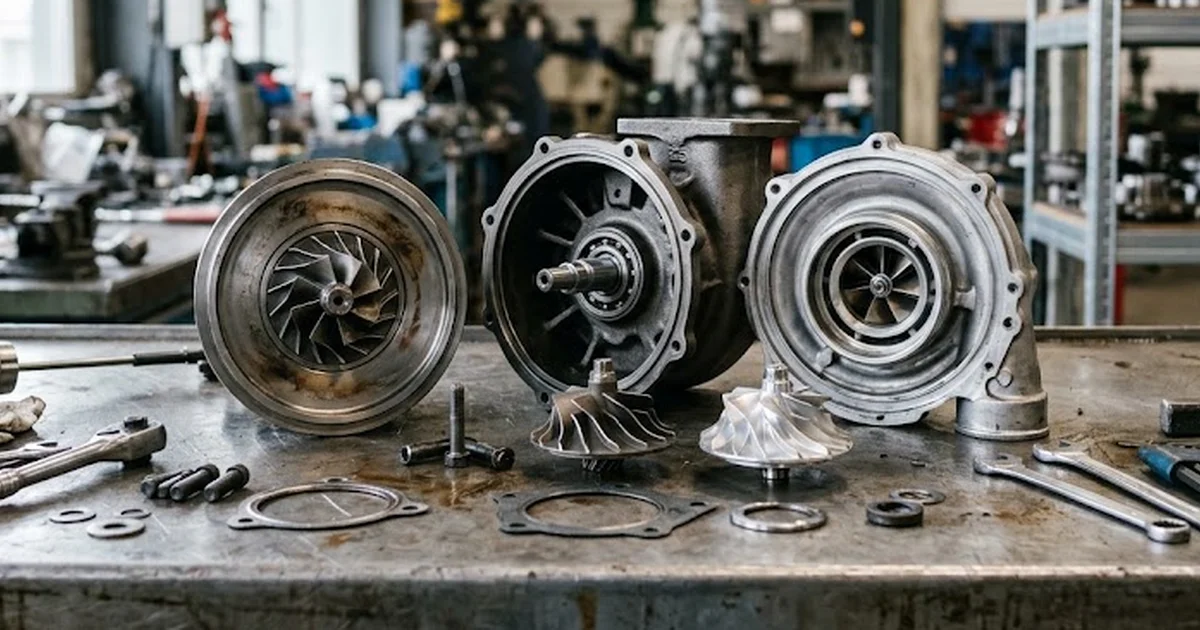
Failed Turbo: Symptoms That Should Alert You Before Complete Breakdown
Whistling, blue smoke, power loss: discover the signs of a failing turbo and act before complete engine breakdown.
A turbocharger rarely fails suddenly without warning. In the vast majority of cases, it sends out warning signs several days or even weeks before the final breakdown. Recognizing these symptoms allows you to act before the damage spreads to the engine itself, leading to far more costly repairs. This article details the signs that should prompt a quick diagnosis.
Power loss and lack of responsiveness during acceleration
The most frequently reported symptom is a feeling of sluggishness during acceleration, particularly noticeable when overtaking or going uphill. The turbo struggles to build pressure or no longer reaches its nominal boost pressure.
- Acceleration that feels "flat" between 2000 and 3000 rpm
- Need to press the pedal further to get the same response as before
- Feeling of a "restricted" engine even though no warning light is on yet
- Difficulty accelerating on the highway, especially when changing lanes
This gradual power loss is often caused by worn bearings, a seized variable geometry mechanism, or a leak in the intake circuit that prevents proper pressure buildup.
Abnormal exhaust smoke: blue, black, or white
The color of the exhaust smoke is a valuable indicator for guiding the diagnosis. Each shade corresponds to a different failure and deserves special attention.
| Smoke color | Probable cause | Urgency of intervention |
|---|---|---|
| Blue smoke | Engine oil entering the intake side, worn turbo seals | High |
| Black smoke | Unbalanced air/fuel mixture, lack of air pressure | Moderate to high |
| Thick white smoke | Presence of coolant, blown head gasket or turbo oil cooler | Very high |
| Persistent gray smoke | Combination of internal turbo wear and DPF clogging | Moderate |
Blue smoke when starting from cold, which then disappears, is still tolerable in an older vehicle. However, continuous blue smoke while driving indicates an active oil leak in the turbo, which should not be ignored.
Unusual noises: whistling, rumbling, and metallic clattering
The ear is often the first diagnostic tool available to any attentive driver. The turbocharger spins at very high speeds, and the slightest internal mechanical play generates a characteristic noise.
- High-pitched whistling during acceleration: classic sign of an air leak in the hoses or clamps of the boost circuit
- Deep, low rumbling that intensifies with engine speed: worn internal turbo shaft bearings
- Metallic clattering at idle or during acceleration: excessive turbine play, abnormal contact between blades and housing
- Constant high-pitched whistling, even with a cold engine: possible crack or leak in the exhaust manifold
At autoKUR, we regularly receive vehicles whose drivers describe a simple "strange whistling for the past fifteen days." In more than half of the cases we handle, the turbo already shows abnormal axial play at this stage. Our field advice: never wait until the noise becomes bothersome to have the turbo unit checked, as it is precisely within this window of a few weeks that the repair remains simple and affordable.
Oil leaks, excessive consumption, and dashboard warning lights
The turbocharger is continuously lubricated by engine oil, under pressure and at high temperatures. Any seal failure quickly results in abnormal oil consumption and sometimes the illumination of warning lights.
- Check the oil level more frequently than usual
- Look for oil traces around the turbo during a visual inspection
- Monitor the appearance of the engine warning light or the "power loss" message on the dashboard
- Note any smell of burning oil in the cabin or under the hood
- Check the color and smell of exhaust gases when cold and hot
Significant oil consumption between two oil changes, without visible leaks on the ground, often points to a failing turbo seal that allows oil to pass into the intake or exhaust side.
Comparison of symptoms based on the turbo's wear stage
To better assess the severity of the situation, it is useful to cross-reference the observed symptoms with the turbocharger's probable wear stage. This reference helps prioritize the intervention.
| Stage | Typical symptoms | Recommended action |
|---|---|---|
| Early | Occasional slight whistling, very slight power loss | Visual inspection and preventive diagnosis |
| Intermediate | Intermittent blue smoke, more frequent noise, increasing oil consumption | In-depth diagnosis within 1 to 2 weeks |
| Advanced | Engine warning light on, clear power loss, continuous smoke | Quick intervention, avoid long trips |
| Critical | Loud metallic noise, dense smoke, permanent limp mode | Stop the vehicle, tow to a garage |
Common causes behind a turbo showing signs of weakness
Understanding why a turbocharger wears out prematurely helps prevent the problem from recurring after repair or replacement. Several causes regularly appear in diagnoses.
- Oil changes not followed or unsuitable oil quality, leading to clogging of lubrication channels
- Sudden engine shutdown after high-speed driving, without a cooling period at idle
- Clogged air filter forcing the turbo to work under poor conditions
- Air leaks in the intake circuit forcing the turbo to compensate by spinning faster
- Clogging of the EGR system or DPF disrupting exhaust pressure
- Prolonged use at low rpm with repeated harsh acceleration
These factors, often combined, accelerate the wear of bearings and internal seals, hastening the appearance of the symptoms described above.
What to do when the first warning signs appear
Faced with any of these symptoms, responsiveness often changes the nature of the required intervention: a simple preventive check versus a complete turbocharger replacement, or even a more extensive engine repair in case of subsequent damage.
- Reduce harsh engine demands while awaiting diagnosis
- Avoid long high-speed trips until the cause is identified
- Check the engine oil level and condition without delay
- Request a professional diagnosis at the first suspicious noises
- Do not ignore an engine warning light, even if the vehicle seems to drive normally
An early diagnosis often allows identifying a peripheral cause, such as a cracked hose or a clogged filter, before the turbo itself is irreversibly damaged.
Summary: Anticipate rather than endure turbo failure
The symptoms of a failing turbo are rarely silent: whistling, power loss, abnormal smoke, excessive oil consumption, or dashboard warning lights are all signals that deserve immediate attention. Delaying diagnosis not only risks complete failure but also the possibility of collateral damage to the engine, which is far more costly to repair. Regular checks and careful attention to the vehicle's behavior remain the best allies for preserving the turbocharger's lifespan. For any questions regarding turbo replacement or reconditioning, the Turbocharger section of the site lists available references by model and engine type.
Also read
A question?
Get in touch directly.

Discussion
Our advice related to Turbocharger
 Turbocharger
Why Is My Turbo Whistling? Warning Signs and Causes
Is your turbo whistling under acceleration? Discover the differences between normal spooling and mechanical failure, from boost leaks to bearing play.
 Turbocharger
How Much HP Does a Turbo Add? Power Gains & Costs
Learn how much horsepower a turbo adds across engine sizes, what drives replacement costs, and how standard exchange delivers full factory performance.
 Turbocharger
Is a Turbo Covered Under Warranty? Coverage & Exclusions
Wondering if a turbo is covered under warranty? Learn what parts guarantees protect, common failure exclusions, and essential claim requirements to know.