
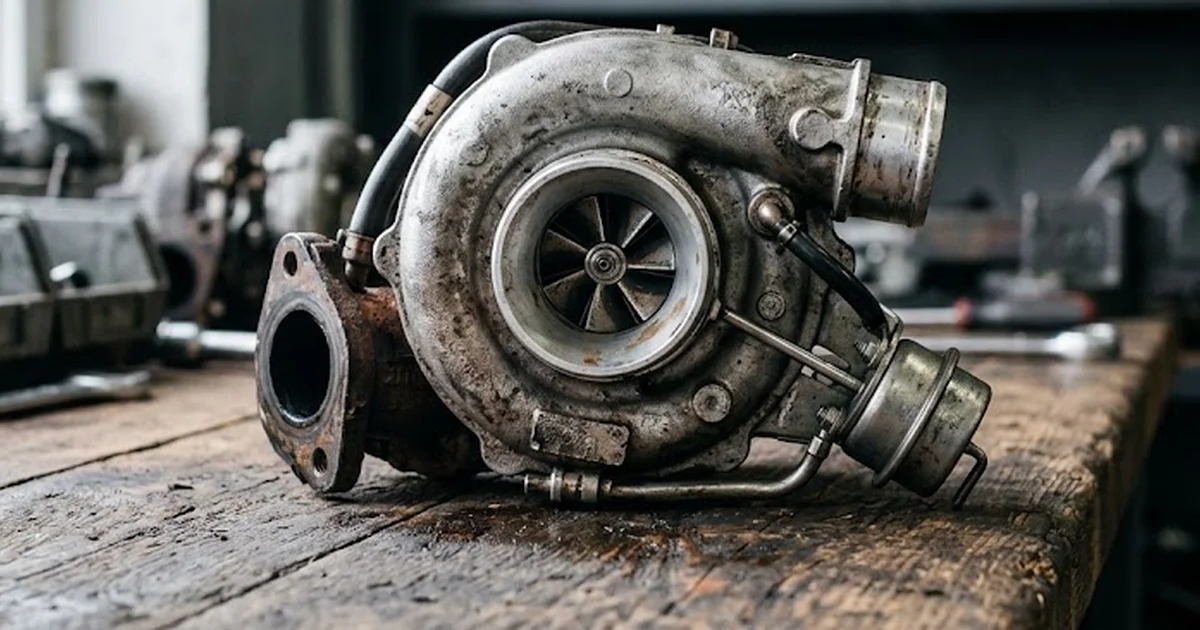
Cheap turbo: price level and what causes it to vary
Discover the price ranges for a cheap turbo and the technical factors that cause them to vary: condition, geometry, brand, and additional costs.
Finding a cheap turbo is a legitimate concern when a vehicle breaks down or shows signs of weakness during acceleration. But behind this search lies a more complex question: what justifies a turbocharger costing €150 here and €800 elsewhere for an apparently similar model? This article details the actual market price ranges and, more importantly, the technical and commercial factors that explain these differences, so you can buy with full knowledge rather than relying solely on the displayed price.
What is the actual price range for a cheap turbo on the market?
The term "cheap" covers very different realities depending on the type of vehicle, the brand, and the condition of the part. A turbo for a diesel city car will never have the same price positioning as a turbo for a high-performance petrol engine or a heavy-duty commercial vehicle.
| Type of vehicle | New turbo (entry-level) | Reconditioned turbo | Used turbo |
|---|---|---|---|
| Diesel city car (1.3 to 1.6L) | 180 to 350 euros | 120 to 220 euros | 60 to 130 euros |
| Diesel saloon (1.9 to 2.0L) | 250 to 450 euros | 150 to 280 euros | 80 to 160 euros |
| Light commercial vehicle | 300 to 550 euros | 180 to 320 euros | 100 to 200 euros |
| High-performance petrol vehicle | 400 to 900 euros | 250 to 500 euros | 150 to 350 euros |
These ranges provide a basis for comparison, but they still vary depending on the availability of the reference, the time of year, and supply chain pressures on electronic components used in variable-geometry turbos.
New, reconditioned, or used turbo: what impact on the price?
The first factor affecting the price of a turbo is not the vehicle brand, but the condition of the part offered. Three main categories exist on the market, each with very different economic considerations.
- The new turbo: manufactured from original components, it offers the best longevity guarantee but remains the most expensive solution.
- The reconditioned turbo (exchange standard): the cylinder head and housing are reused after inspection, while wear parts (bearings, seals, actuator) are replaced. This is the most sought-after compromise for a reliable yet cheap turbo.
- The raw used turbo: sourced from a car breaker, it has undergone no in-depth inspection. Its attractive price often hides a high risk of rapid failure.
A turbo reconditioned by a reputable professional generally offers a better quality-to-price ratio than a low-cost new turbo of uncertain origin, as the quality control focuses on parts already validated in real-world conditions.
Which technical factors increase or decrease the price of a turbo?
Beyond the general condition of the part, several technical characteristics directly influence the final price of a turbocharger. Understanding these elements helps avoid unpleasant surprises and negotiate a better purchase.
- Geometry technology: a fixed-geometry turbo is structurally cheaper than a variable-geometry turbo, which is more mechanically and electronically complex.
- The presence of an electronic actuator: turbos controlled by a solenoid valve or electric actuator include an additional, non-negligible component cost.
- Engine displacement and power: the greater the airflow to manage, the larger the turbo size and its manufacturing cost.
- The rarity of the reference: a turbo fitted on a rarely produced or older model often costs more due to low production volumes.
- Quality control level: dynamic balancing, bench testing, oil pressure checks—each verification step adds a cost that is reflected in the final price.
It is common to find that an apparently "low-cost" turbo actually lacks several of these checks, which explains why two visually identical references can show a price difference of over €100.
Vehicle brand and availability: underestimated variables
The vehicle's brand and model play an often underestimated role in determining the price of a turbo. Some mainstream brands benefit from mass production that drives prices down, while others, more premium or less common, experience the opposite effect.
- Turbos for high-volume vehicles benefit from increased competition among suppliers, which mechanically lowers prices.
- Turbos for premium or niche vehicles have higher prices due to limited production and specific references that are difficult to standardise.
- Immediate availability of a part in stock avoids special order fees, often charged as an extra by some distributors.
- Recent turbos, still under strict manufacturing rights, are offered at firmer prices than older references, which are widely copied or reconditioned.
How to spot a cheap turbo without compromising reliability?
Looking for a cheap turbo does not necessarily mean sacrificing quality. There are concrete criteria to identify a genuinely advantageous offer rather than a low price that hides a significant mechanical risk.
At autoKUR, we regularly observe that the lowest price is never synonymous with the best choice. A turbo sold without a guarantee, without reconditioning traceability or bench testing, almost always ends up costing more than expected once the installation and labour are billed a second time. Our advice: always prioritise a part with a clearly stated control history, even if its price is slightly higher than the cheapest offer on the market.
Here are the key points to check systematically before finalising a purchase:
- The presence of a written guarantee, with a clearly specified minimum duration.
- The explicit mention of bench testing or a leak test after reconditioning.
- The exact match of the manufacturer reference with the vehicle's serial number.
- The visual condition of the turbine and housing, without signs of corrosion or excessive play during manual rotation.
- The return or exchange policy in case of non-compliance upon receipt.
Additional costs and total price: what the displayed price does not always show
The price of a cheap turbo represents only part of the real cost of an intervention. Several additional costs, often overlooked during the initial comparison, can significantly impact the final budget.
| Cost item | Indicative range | Variation factor |
|---|---|---|
| Installation labour | 150 to 400 euros | Access complexity depending on the model |
| Installation kit (gaskets, hoses) | 20 to 60 euros | Need to replace original gaskets |
| Associated engine oil change | 50 to 120 euros | Recommended precaution after turbo failure |
| Shipping costs for specific part | 0 to 30 euros | Stock availability or on-demand order |
This table illustrates why it is essential to consider the total cost rather than just the unit price of the part. A turbo advertised at €50 less than a competitor can quickly lose this advantage if the installation kit is not provided or if the guarantee is absent.
Common mistakes when buying a turbo at the lowest price
Some purchasing practices, though intuitively logical, often lead to costly disappointments in the medium term.
- Choosing solely based on the displayed price without verifying the exact turbo reference.
- Overlooking the origin of the reconditioning, sometimes done without fully disassembling the central unit.
- Ignoring the condition of the lubrication and cooling system, often responsible for recurring turbo failures.
- Failing to check the compatibility of the electronic actuator with the vehicle's ECU.
Summary: how to properly assess the price of a turbo before purchase
The price range of a cheap turbo depends on a combination of factors: the condition of the part (new, reconditioned, used), the technical complexity of the geometry and actuator, the rarity of the reference linked to the vehicle brand, and the level of quality control applied before resale. Comparing only displayed prices without considering these elements exposes you to hidden costs that quickly negate the initial savings. A methodical approach, taking into account the guarantee, traceability, and total installation cost, allows for a truly cost-effective choice in the long run.
To explore all available references and compare models suited to your vehicle, the Turbocharger category groups the complete range sorted by engine type and vehicle.
A question?
Get in touch directly.

Discussion
Our advice related to Turbocharger
 Turbocharger
Why Is My Turbo Whistling? Warning Signs and Causes
Is your turbo whistling under acceleration? Discover the differences between normal spooling and mechanical failure, from boost leaks to bearing play.
 Turbocharger
How Much HP Does a Turbo Add? Power Gains & Costs
Learn how much horsepower a turbo adds across engine sizes, what drives replacement costs, and how standard exchange delivers full factory performance.
 Turbocharger
Is a Turbo Covered Under Warranty? Coverage & Exclusions
Wondering if a turbo is covered under warranty? Learn what parts guarantees protect, common failure exclusions, and essential claim requirements to know.