
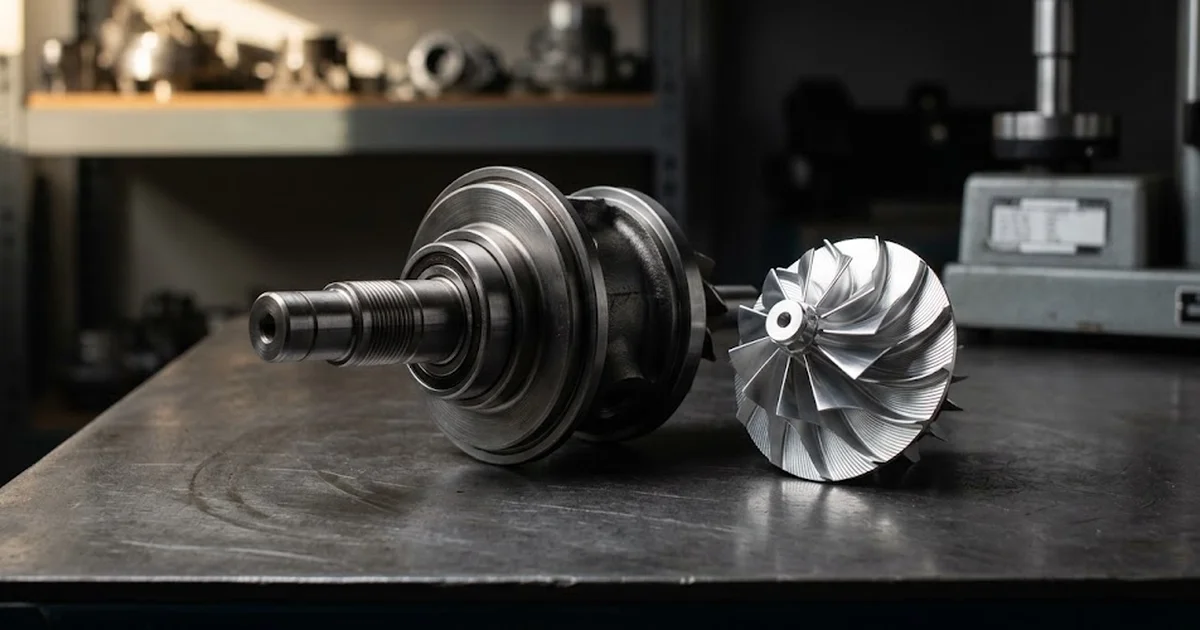
How much horsepower does a turbo add?
Discover how much horsepower a turbo adds to naturally aspirated and factory turbocharged engines. Learn realistic HP gains, boost math, and upgrade costs.
The Physics of Forced Induction: How a Turbocharger Generates Horsepower
An internal combustion engine functions fundamentally as an air pump. Power output is governed directly by the mass of air drawn into the cylinders and the corresponding volume of fuel that can be burned within a safe stoichiometric window. In a naturally aspirated engine, incoming airflow is restricted by ambient atmospheric pressure, which averages approximately 14.7 PSI (1.013 bar) at sea level. Forced induction fundamentally alters this limitation by compressing ambient air before it reaches the combustion chamber, allowing a dramatically denser oxygen charge to enter each cylinder during the intake stroke.
To understand how a turbocharger works to produce additional horsepower, one must evaluate the relationship between pressure ratio, air density, and thermodynamic efficiency. Doubling the absolute pressure inside the intake manifold from 1.0 bar absolute (atmospheric) to 2.0 bar absolute (adding 1.0 bar or 14.5 PSI of positive boost) theoretically doubles the mass of oxygen available for combustion. However, practical power gains do not scale in a purely linear one-to-one fashion due to thermal dynamics and exhaust flow restrictions established by SAE International technical standards governing forced induction testing.
When air is compressed rapidly by a spinning compressor wheel rotating between 100,000 and 250,000 RPM, its temperature rises significantly according to the ideal gas law. Hot air is less dense than cold air, which reduces the effective oxygen concentration per cubic centimeter and increases the risk of engine knock or pre-ignition. Furthermore, driving the compressor requires an exhaust turbine placed directly in the engine exhaust stream, which inherently creates exhaust manifold backpressure. As a result, usable horsepower gains depend on several thermodynamic trade-offs:
- Compressor adiabatic efficiency: High-efficiency compressor wheels generate less heat during compression, delivering denser intake air at identical manifold pressure.
- Charge air cooling: An effective intercooler lowers intake air temperatures by dozens of degrees, recovering lost air density and protecting internal engine components from thermal stress.
- Turbine backpressure penalty: Pumping losses occur when high exhaust backpressure resists piston movement during the exhaust stroke, slightly offsetting raw combustion gains.
- Ignition timing adjustments: Engine management systems must often retard ignition timing under higher boost levels to suppress detonation, trading marginal peak power for structural safety.
Realistic Horsepower Gains Across Different Engine Configurations
The actual horsepower added by a turbocharger varies drastically depending on whether you are converting a naturally aspirated engine to forced induction, remapping a factory turbocharged vehicle, or replacing a factory unit with an upgraded hybrid turbocharger. Each scenario presents entirely different mechanical baselines, compression ratios, and component tolerances.
On a vehicle that left the factory naturally aspirated, introducing a low-to-moderate boost pressure of 6 to 8 PSI (0.4 to 0.55 bar) typically yields a 30% to 50% increase in baseline horsepower. For example, a 2.0-liter naturally aspirated engine producing 150 horsepower will routinely reach 200 to 220 horsepower with a conservative, properly intercooled setup. Exceeding this threshold on stock internals is usually limited by the engine static compression ratio, which is typically higher in non-turbo engines (often 10.5:1 to 12.0:1) to maximize natural thermal efficiency. High static compression combined with aggressive boost causes rapid cylinder pressure spikes that stock cast pistons and connecting rods cannot withstand.
Conversely, modern factory turbocharged petrol and diesel engines feature lower static compression ratios (typically 8.5:1 to 9.8:1 for petrol) and factory-strengthened rotating assemblies. When working with a platform that is already turbocharged, extracting additional horsepower follows three distinct tiers of modification:
- Software calibration (ECU remap / Stage 1): Increasing factory boost levels by 3 to 5 PSI (0.2 to 0.35 bar) within the factory compressor efficiency map typically adds 15% to 25% more horsepower without changing any mechanical hardware.
- Bolt-on hardware with matching calibration (Stage 2): Adding a high-flow downpipe, enlarged intercooler, and free-flowing intake allows the turbocharger to operate against lower exhaust backpressure, yielding 25% to 40% over original factory output.
- Turbocharger upgrade or hybrid replacement (Stage 3): Installing a larger turbocharger or a modified core with larger turbine and compressor wheels can increase baseline power by 50% to 100% or more, provided the fuel supply system and engine block can handle the increased airflow and torque load.
Key Mechanical Variables Dictating Maximum Horsepower Gains
A turbocharger cannot generate power in isolation. It operates as part of an interdependent powertrain system where airflow, fueling, exhaust scavenging, and engine timing must remain synchronized. When attempting to calculate how much horsepower a specific turbocharger can support, mechanics and performance specialists examine four fundamental mechanical boundaries.
The first boundary is compressor wheel sizing and flow rating. Every turbocharger compressor has a defined compressor map displaying its mass flow capacity measured in pounds per minute (lb/min) or cubic meters per second. As a general rule of thumb, one pound of air per minute equates to roughly 10 to 11 horsepower under optimal combustion conditions. A small factory turbo rated for 30 lb/min will mathematically max out at approximately 300 to 330 horsepower, regardless of how much boost pressure the wastegate is forced to hold. Attempting to push a small compressor beyond its choke line merely superheats the intake charge without increasing mass airflow.
The second variable is fuel delivery capacity. Generating additional horsepower requires burning more fuel in exact proportion to the additional air mass entering the cylinders. If the fuel injectors or high-pressure fuel pump reach 100% duty cycle, the air-fuel mixture leans out instantly. In turbocharged applications, a lean condition under boost leads to catastrophic cylinder temperatures, melting piston crowns and cracking exhaust valves within seconds. Any serious increase in turbo power must be paired with verified injector flow margins.
The third factor centers on turbine housing aspect ratio (A/R) and exhaust scavenging. A small turbine housing spools rapidly at low engine speeds, providing instantaneous throttle response and high low-end torque, but creates immense exhaust backpressure at high RPM. A larger turbine housing reduces backpressure and unleashes substantial top-end horsepower, but introduces noticeable turbo lag below 3,000 RPM. Precision remanufactured OE-specification units, such as a factory-calibrated MAHLE 030TC11001000 turbocharger, are engineered precisely to balance early spool-up with sufficient exhaust flow to sustain factory-rated output reliably over hundreds of thousands of kilometers.
- Intake charge temperatures: For every 10 degrees Celsius reduction in intake air temperature achieved by an efficient intercooler, intake charge density increases by approximately 3%, translating directly into clean horsepower gains.
- Exhaust gas temperatures (EGT): Excessive exhaust heat before the turbine wheel causes thermal expansion issues and blade creep, limiting the maximum safe sustained power output.
- Cylinder head flow and valve overlap: If cylinder head ports and camshaft profiles restrict volumetric efficiency at higher engine speeds, increasing boost pressure yields diminishing returns.
- Oil supply and thermal management: High-power operation places extreme shear and thermal loads on the turbocharger journal bearings and central cartridge, demanding clean, uninhibited oil delivery.
Horsepower Gains by Displacement and Boost Pressure
To provide a clear, empirical framework of what to expect across common passenger car and light commercial engine configurations, the following table compares baseline power ratings, applied boost levels, and realistic horsepower increases under professional dyno testing and road conditions.
| Engine Configuration | Baseline Output (HP) | Added Boost Level | Typical Gain (HP) | Expected Total Output | Primary Supporting Upgrades Required |
|---|---|---|---|---|---|
| 1.0L - 1.2L 3-Cylinder Petrol (Factory Turbo) | 90 - 110 HP | +4 to 6 PSI (+0.3 to 0.4 bar) | +20 to 30 HP | 110 - 140 HP | ECU software calibration, premium high-octane fuel |
| 1.6L - 2.0L 4-Cylinder Petrol (Naturally Aspirated) | 130 - 160 HP | 7 to 8 PSI (0.5 bar base setup) | +50 to 75 HP | 180 - 235 HP | Turbo manifold, standalone/piggyback ECU, larger injectors, front-mount intercooler |
| 2.0L 4-Cylinder Petrol (Factory Turbo, e.g. Hot Hatch) | 220 - 250 HP | +6 to 8 PSI (+0.4 to 0.55 bar) | +50 to 70 HP | 270 - 320 HP | High-flow downpipe, uprated intercooler, high-pressure fuel pump upgrade |
| 2.0L 4-Cylinder Diesel (Factory Turbodiesel) | 140 - 170 HP | +4 to 6 PSI (+0.3 to 0.4 bar) | +30 to 45 HP | 170 - 215 HP | ECU remap, transmission torque limiter adjustment, particulate filter monitoring |
| 3.0L 6-Cylinder Petrol (Factory Twin-Turbo) | 300 - 340 HP | +5 to 7 PSI (+0.35 to 0.5 bar) | +70 to 100 HP | 370 - 440 HP | Charge pipe reinforcement, upgraded intercooler, intake tract optimization |
| Larger Turbocharger Upgrade / Hybrid Swap (2.0L Platform) | 200 - 240 HP | +10 to 14 PSI (+0.7 to 1.0 bar) | +100 to 160 HP | 300 - 400 HP | Forged pistons, uprated connecting rods, high-flow injectors, custom dyno tuning |
As demonstrated in the table, engine displacement dictates the total volume of air that can be compressed per cycle. A small 1.2-liter engine can achieve an impressive percentage increase in power, but the absolute horsepower gain remains constrained by displacement volume. In contrast, larger 2.0-liter and 3.0-liter platforms provide a broader volumetric foundation, allowing identical boost pressure increases to translate into substantially higher gross horsepower figures.
Costs, Investment Factors, and Budget Expectations
Extracting horsepower from forced induction requires an honest assessment of financial investment. While the turbocharger itself is the central component, it rarely accounts for more than half the total budget when increasing performance safely. In our experience, owners who underestimate auxiliary costs frequently face premature breakdowns or uncalibrated running issues.
Understanding what drives the price of forced induction requires analyzing the baseline condition of the vehicle and the route chosen for hardware acquisition:
- The core turbocharger unit: When replacing a worn turbocharger or restoring lost factory power, choosing a professional remanufactured unit through a standard core deposit system delivers original equipment performance at a fraction of the cost of dealership parts. For detailed pricing metrics across vehicle tiers, motorists should consult a comprehensive car turbocharger price guide before commissioning work.
- Intake and thermal management components: An efficient front-mount or air-to-water intercooler, silicone induction hoses, and heat shielding prevent heat soak from sapping the horsepower gains produced by increased boost.
- Exhaust flow components: A restrictive catalytic converter or narrow factory downpipe traps hot exhaust gases against the turbine wheel. Upgrading to a mandrel-bent exhaust system reduces backpressure, allowing the turbocharger to spool faster and yield higher peak power.
- Fuel system adaptation: High-output setups require larger fuel injectors and high-pressure fuel pumps to prevent lean combustion conditions at wide-open throttle.
- Software calibration and dyno tuning: Flashing the engine control module to optimize ignition timing, target air-fuel ratios, and electronic wastegate duty cycles ensures that mechanical gains translate into reliable road performance.
- Professional installation and commissioning: Mounting a turbocharger requires flushing the engine oil supply lines, replacing oil feed and return pipes, and installing fresh seals using a dedicated complete turbocharger gasket kit to prevent boost leaks and oil starvation.
Reliability, Mechanical Ceilings, and Preventing Engine Failure
Every engine platform possesses a mechanical breaking point where structural cylinder pressure exceeds the tensile strength of factory hardware. When you increase horsepower by adding boost, cylinder pressures rise proportionally, placing heavier mechanical loads on the wrist pins, connecting rods, head bolts, and crankshaft main bearings. Exceeding these limits without internal reinforcement leads to bent connecting rods, blown head gaskets, or cracked ring lands.
autoKUR Workshop Insight: When planning for increased power output, focus on thermal efficiency and exhaust flow rather than merely pushing higher peak boost numbers on an uncalibrated wastegate. In our remanufacturing and technical inspection work, premature turbine shaft play and compressor wheel contact almost always stem from excessive backpressure and inadequate oil drainage rather than inherent metallurgy failure. Matching the correct compressor trim to the specific engine code is what guarantees lasting performance.
To preserve engine longevity while enjoying noticeable power increases, mechanics and tuners must monitor operating conditions continuously rather than relying solely on dyno figures. Keeping an engine operating inside its engineered safety envelope involves several mandatory safeguards:
- Exhaust Gas Temperature (EGT) monitoring: Sustained exhaust temperatures above 900 degrees Celsius can distort turbine housings, degrade turbine wheel metallurgy, and scorch exhaust valves.
- Oil quality and cooling intervals: Turbocharged engines subject engine oil to extreme shear forces and localized temperatures exceeding 200 degrees Celsius inside the center housing. Synthetic oil changed at disciplined intervals is non-negotiable.
- Cool-down periods post-driving: Idling a turbocharged engine for 30 to 60 seconds after spirited driving allows oil to circulate while the turbine cools down, preventing oil coking in the bearing housing.
- Controlled boost ramping: Applying maximum boost gradually across the mid-range RPM band prevents excessive low-end torque spikes that bend connecting rods at low engine speeds.
Achieving Balanced Performance and Long-Term Reliability
Determining how much horsepower a turbocharger adds ultimately comes down to the balance between air mass flow, fuel volume, thermal efficiency, and mechanical strength. Under conservative, street-reliable calibrations, introducing forced induction to a naturally aspirated engine reliably adds 30% to 50% more horsepower, while recalibrating or upgrading an existing factory turbocharged platform unlocks 15% to 40% additional power without compromising everyday drivability.
Chasing peak horsepower numbers without respecting component tolerances invariably leads to diminished reliability, boost leaks, and premature turbocharger failure. Whether you are replacing a fatigued factory unit to restore original dynamic performance or assembling a robust setup for enhanced towing and responsiveness, selecting high-precision components built to strict tolerances remains the decisive factor.
If your current vehicle is experiencing sluggish acceleration, boost pressure drops, or excessive turbine wear, explore our complete replacement turbocharger catalog to find precision-remanufactured, factory-calibrated standard exchange units matched exactly to your vehicle make, engine displacement, and original manufacturer specifications.
Frequently asked questions
Everything you need to know about this topic.
A question?
Get in touch directly.

Discussion
Our advice related to Turbocharger
 Turbocharger
What Is Turbo Lag? Causes, Symptoms & Solutions | autoKUR
Understand what turbo lag is, how it differs from boost threshold, and how to diagnose sluggish throttle response. Expert mechanical advice by autoKUR.
 Turbocharger
What Is a Twin Scroll Turbo? How It Works & Benefits
Discover what is a twin scroll turbo, how divided exhaust scrolls eliminate lag, boost low-end torque, and optimize efficiency. Complete technical guide.
 Turbocharger
Why Is My Turbo Whistling? Warning Signs and Causes
Is your turbo whistling under acceleration? Discover the differences between normal spooling and mechanical failure, from boost leaks to bearing play.