
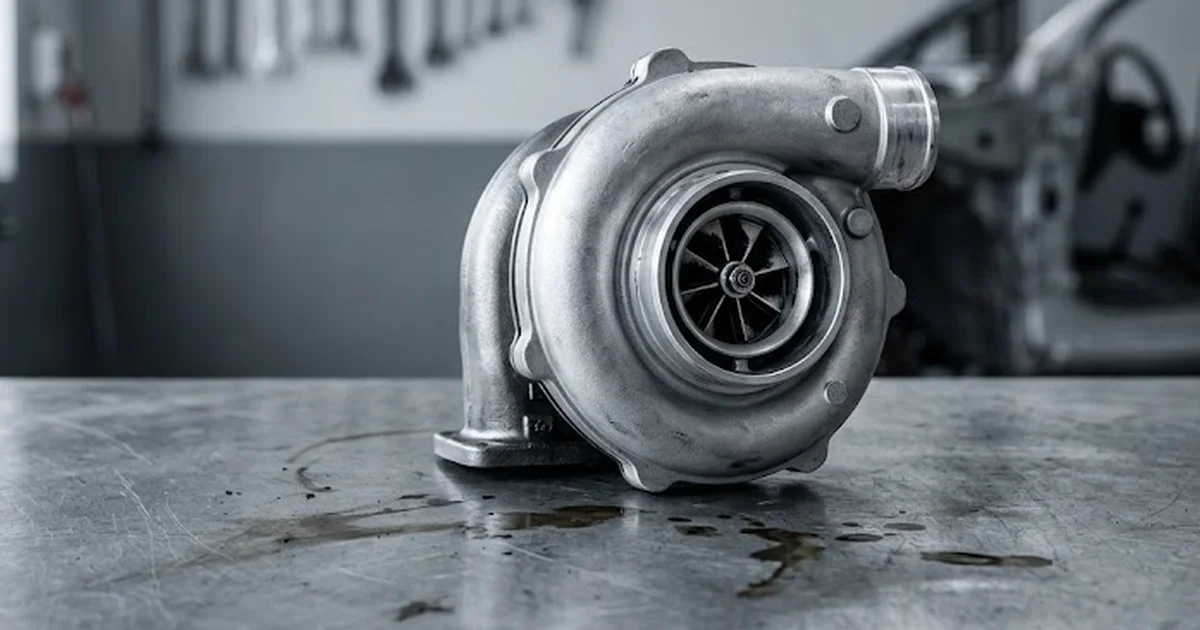
How long can you drive with a failing turbo?
Failing turbo: what symptoms precede total breakdown and how long can you still drive safely? Complete guide and expert advice.
A turbo that is starting to fail does not always send a clear signal. It is often a combination of small signs—a loss of power here, an unusual noise there—that should alert you before the breakdown becomes total and costly. Understanding how long it is reasonable to continue driving under these conditions helps avoid much more serious engine damage than simply replacing the turbocharger.
Why a turbo never fails without warning
Contrary to popular belief, a turbocharger almost never breaks down overnight without showing prior symptoms. The degradation is gradual: excessive play in the bearings, oil leaks, wear on the blades, or clogging of the intake ducts. These issues develop over several weeks, sometimes months, before reaching a critical stage.
The problem is that many drivers misinterpret these early signs, attributing them to a simple drop in vehicle performance or a fuel issue. This lack of awareness delays diagnosis and leads to continued driving even when the turbo is already in an advanced stage of degradation.
- A gradual loss of power, especially uphill or during sharp acceleration
- Abnormal exhaust smoke, bluish or black depending on the nature of the leak
- A high-pitched whistling noise that intensifies with engine speed
- Higher than normal engine oil consumption
- An engine warning light that comes on intermittently and then stays on
How long can you drive with a failing turbo without risking engine damage
This is the central question many motorists ask when faced with these early symptoms. The answer depends directly on the stage of wear and the type of failure involved. A turbo with a minor oil leak may still function for a few hundred kilometers, whereas a turbo with partially broken blades can fail at any moment, sometimes within just a few kilometers.
There is no universal answer in terms of kilometers or days, as each situation depends on the severity of the wear, the driving style, and the vehicle's operating conditions. What is certain is that the more pronounced the symptoms, the more drastically the time before total failure is reduced.
At autoKUR, we regularly see vehicles whose turbo has completely failed even though the driver had noticed the first signs several weeks earlier. Our conviction, forged by years of observation in the workshop, is that a turbo that starts whistling or smoking should never be ignored for more than a few days. Delaying diagnosis risks turning a repair costing a few hundred euros into a complete engine overhaul.
Early signs that should alert you before total failure
Some symptoms are more revealing than others and require immediate attention. Recognizing them allows you to anticipate the breakdown and limit repair costs by intervening before the turbo damages other engine components.
Abnormal noises
A high-pitched whistling noise that increases with engine speed is often the first audible sign of a turbo problem. It may indicate an air leak in the intake system, excessive play in the bearings, or the beginning of blade friction against the housing.
Exhaust smoke
Bluish smoke generally signals an oil leak passing into the exhaust side, while thick black smoke may indicate excess fuel due to poor air pressure. Both situations reflect a well-advanced failure.
Loss of power
An engine that lacks power, particularly at low speeds or under load, often signals insufficient boost pressure. This can stem from a leak in the pipes, a faulty wastegate, or internal wear of the turbo itself.
Summary table of symptoms and recommended time before intervention
To help assess the urgency of the situation, here is a summary table presenting the main symptoms observed, their severity, and the reasonable time before intervention.
| Observed symptom | Estimated severity | Recommended time before diagnosis |
|---|---|---|
| Occasional slight whistling | Low to moderate | A few days, no more than a week |
| Bluish smoke from the exhaust | Moderate to high | Immediate, within 48 hours |
| Clear and continuous loss of power | High | Immediate, stop driving advised |
| Metallic noise or grinding | Critical | Immediate stop, do not drive |
| Engine warning light on permanently | High to critical | Diagnosis within 24 to 48 hours |
| Abnormal oil consumption | Moderate | Within a week, close monitoring |
Mechanical risks of continuing to drive with a failing turbo
Ignoring the symptoms of a failing turbo is not just a minor driving inconvenience. The mechanical consequences can extend to components far more expensive to replace than the turbocharger itself.
When a turbo fails suddenly, metal debris from the blades or bearings can scatter into the intake and exhaust ducts. These fragments can then damage the engine internally, clog the particulate filter, or deteriorate the EGR valve.
- Contamination of the engine oil circuit by metal particles
- Clogging or destruction of the particulate filter
- Damage to valves from debris ingestion
- Premature wear of piston rings due to poor lubrication
- Risk of engine stalling in traffic, a road hazard
These additional repairs can multiply the initial cost of a simple turbo intervention by three or four, not to mention the prolonged immobilization of the vehicle.
What to do immediately at the first signs of a failing turbo
Faced with these signals, adopting the right approach helps limit damage and preserve the engine's long-term health. Here are the steps to take as soon as doubts arise.
- Immediately reduce engine speed and avoid sharp acceleration
- Check the engine oil level and quality without delay
- Visually inspect for leaks or oil traces around the turbo
- Schedule a full diagnosis with a professional within the next few days
- Avoid long trips or highway driving until the diagnosis is complete
An early check often helps distinguish between a simple hose wear and a genuine internal turbo failure, thus avoiding unnecessary costs or, conversely, excessive risk-taking.
Anticipate rather than endure: the key to preserving your engine
The length of time you can drive with a failing turbo therefore largely depends on the nature and intensity of the symptoms observed. In all cases, the faster the response, the greater the chances of limiting damage and repair costs.
Regular maintenance, attention to vehicle noises and performance, and prompt replacement at the first signs of weakness are the best guarantees to avoid a total breakdown while driving. Vigilance remains, in this area as in many others in automotive mechanics, the best long-term investment.
To further explore choosing a turbocharger suited to your vehicle, the Turbocharger section of the site presents the available references for a replacement that meets original specifications.
Also read
A question?
Get in touch directly.

Discussion
Our advice related to Turbocharger
 Turbocharger
Why Is My Turbo Whistling? Warning Signs and Causes
Is your turbo whistling under acceleration? Discover the differences between normal spooling and mechanical failure, from boost leaks to bearing play.
 Turbocharger
How Much HP Does a Turbo Add? Power Gains & Costs
Learn how much horsepower a turbo adds across engine sizes, what drives replacement costs, and how standard exchange delivers full factory performance.
 Turbocharger
Is a Turbo Covered Under Warranty? Coverage & Exclusions
Wondering if a turbo is covered under warranty? Learn what parts guarantees protect, common failure exclusions, and essential claim requirements to know.