
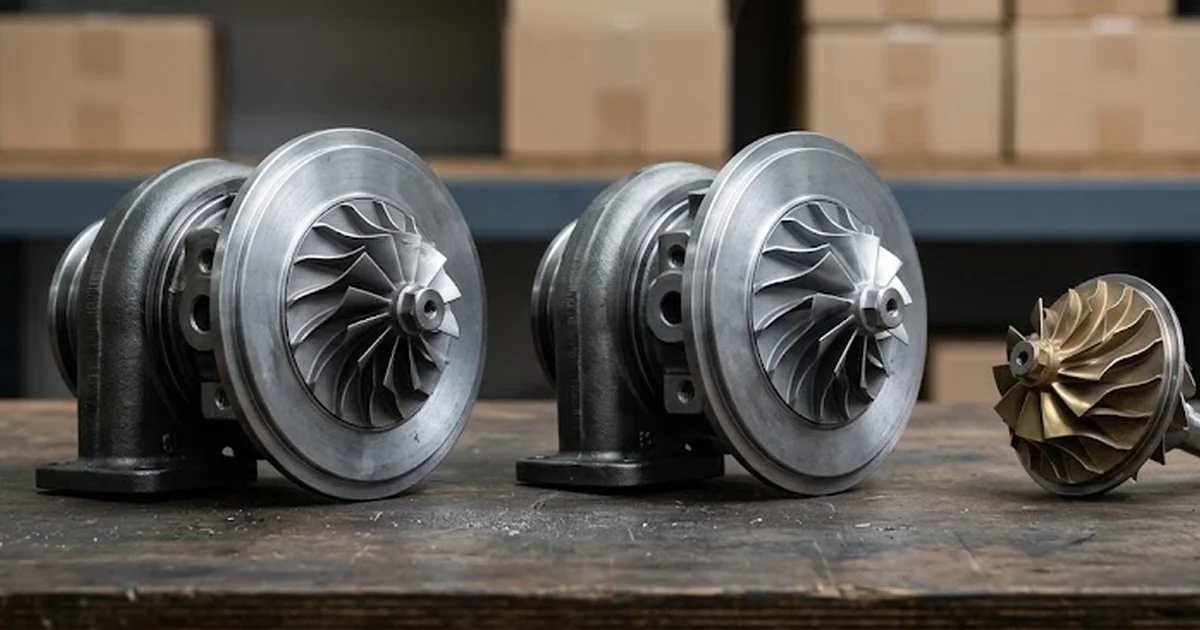
Cheaper turbo: price levels and what causes them to vary
What is the price of a cheaper turbo? Understand what causes price variations between new and standard exchange, the role of the deposit, and pitfalls to avoid.
Understanding price differences: new OEM, used, and standard exchange
When a motorist or professional mechanic faces a failure in the turbocharging system, the question of replacement cost immediately arises. Finding a cheaper turbocharger then becomes a budgetary priority, but this technical approach must in no way compromise the engine's longevity. In today's automotive spare parts market, three main options stand out due to their price level, assembly quality, and the warranties they offer: the new part distributed by manufacturer networks, the used part sourced from auto wreckers, and the remanufactured turbocharger in standard exchange.
| Replacement solution | Relative cost level | Mechanical condition of components | Risks and operational reliability |
|---|---|---|---|
| New OEM part | Highest on the market | 100% new components from the production line | Maximum reliability, but often a disproportionate financial impact on mid-life vehicles |
| Used part (auto wrecker or private seller) | Very low at immediate purchase | Unknown wear history, carbonized oil deposits, potential play in the shaft | High risk of premature failure, no certainty about actual mileage or sealing |
| Remanufactured standard exchange | Intermediate and controlled (net financial gain) | Original casings cleaned, internal wear parts replaced with new, dynamic balancing | Reliability equivalent to new when remanufacturing adheres to manufacturer tolerances |
The price difference between these solutions is explained by the nature of the industrial process involved. The new part bears the costs of foundry amortization and intermediary margins, which significantly increase the final bill. Conversely, the raw used part presents a superficial saving: installing an already worn part exposes the motorist to a second removal in the workshop, thus doubling labor costs. In our detailed comparison on choosing between a new turbo and standard exchange, wear criteria and budget differences are thoroughly examined for each usage profile, demonstrating why industrial remanufacturing is the most rational economic and technical compromise.
What technical factors affect the price of a turbocharger?
Not all turbochargers are equal, and their internal structure directly dictates their manufacturing or remanufacturing cost. A motorist looking for a part for a versatile city car will not face the same price requirements as the owner of a long-distance sedan or a heavy-duty commercial vehicle. Several engineering elements influence the market value of a turbocharging reference.
- Turbocharging regulation technology: a conventional turbo with a wastegate valve has a simpler and more economical mechanical design than a variable geometry turbocharger (VGT or VNT). The latter incorporates a movable ring and adjustable guide vanes subjected to very high thermal stresses, whose recalibration requires a specific flow bench.
- Actuation system: a standard pneumatic control operated by a simple vacuum capsule is less expensive to replace than an electronic actuator communicating via CAN bus. A faulty electronic module requires precise programming and calibration of the rod stroke, or it may trigger overpressure alerts on the dashboard.
- Bearing and lubrication design: high-performance models or some recent engines use ceramic ball bearings instead of traditional hydrodynamic bronze bearings. These specialized assemblies reduce response time (turbo lag) but increase the unit cost of the central cartridge.
- Foundry materials: the exhaust housing, exposed to gases frequently exceeding 850 to 950°C, is cast in nodular cast iron alloyed with silicon and molybdenum, or even in refractory stainless steel for modern turbocharged gasoline engines.
The principle of turbocharging relies on recovering the energy from exhaust gases to drive a turbine connected to a fresh air compressor. The higher the engine displacement and the required boost pressure set by the manufacturer, the more physical constraints demand robust and precisely balanced components. This level of technical requirement justifies the price differences observed between different engine types in the aftermarket.
The deposit mechanism: the essential lever for paying less for your turbo
The economic model of standard exchange is based on the intelligent reuse of components not subject to structural wear. In this circular economy approach applied to the automotive industry, used materials have considerable intrinsic value. When ordering a remanufactured part, a deposit amount (also referred to as a core charge, core deposit, or Pfand) is generally applied to ensure the return of the old defective core to the remanufacturing workshops.
"The valorization of the original metal core is at the heart of the standard exchange model. Recovering a sound exhaust housing and intake housing avoids the complete machining of massive foundry parts while dedicating the technical budget to the full replacement of internal wear parts: central cartridge, bearings, sealing rings, and variable geometry system. It is precisely this balance that makes the remanufactured turbo both high-performing and economically accessible."
The autoKUR technical team
Once the used turbo is received and inspected in the workshop, the financial deposit is refunded to the buyer as long as the core does not show irreversible damage, such as a through crack in the cast iron volute or a pierced housing. This virtuous cycle allows maintaining a closed supply circuit without depending on fluctuating ore prices or the heavy logistics of primary metallurgy. To understand how this deposit works and the conditions for accepting your old part, you can consult the terms of our deposit and core return system to optimize the overall cost of your repair.
The pitfalls of "cheap": why an abnormally low price hides major risks
Faced with an unexpected expense, the temptation to turn to offers at derisory prices on non-specialized general platforms is understandable. However, in the field of mechanical turbocharging, an abnormally low price almost always conceals unacceptable compromises on component quality and assembly steps.
- Use of unbalanced generic CHRA cartridges: a modern turbocharger rotates at dizzying speeds, often exceeding 200,000 revolutions per minute. At these extreme speeds, even the slightest imbalance of a few hundredths of a gram creates destructive vibrational resonance that disintegrates the lubricating oil film and destroys the bearings within a few dozen kilometers.
- Lack of dynamic calibration on a flow bench: on a variable geometry turbo, the minimum stop and the kinematics of the vanes must be adjusted to the nearest micrometer. A low-cost copy assembled by hand without a test bench leads either to chronic lack of pressure (limp mode) or uncontrolled overpressures risking piston perforation or cylinder head damage.
- Fragile substitute alloys: to drive costs down, some non-certified manufacturers use low-density recycled foundry metals. Under repeated heating and cooling cycles, these materials deform, jam the regulation mechanisms, or crack at the wastegate conduit.
- Complete lack of technical traceability: equipment sold without history, balancing data, or workshop technical support leaves no recourse in case of immediate malfunction on the vehicle.
The consequences of turbo failure go far beyond the part itself. The disintegration of a compressor wheel projects metal fragments into the heat exchanger (intercooler) and directly into the engine's combustion chambers, causing complete engine seizure. Similarly, the failure of the dynamic seal leads to massive oil leakage into the air intake, resulting in uncontrolled auto-ignition in diesel engines and irreversible mechanical damage. The apparent savings made at purchase thus turn into a costly and severe engine failure.
How to identify the exact reference to order at the best price?
To obtain a turbocharger at the best price without risking an ordering error that would immobilize the vehicle, it is essential to master the part identification process. Two vehicles of the same model, produced just a few months apart, may have turbos with different characteristics due to changes in anti-pollution emission standards or engine mapping variants.
- Turbocharger nameplate: riveted or laser-engraved on the aluminum intake housing (the cold part of the turbo), this metal badge contains crucial information. It includes the part manufacturer (Garrett, BorgWarner, IHI, Mitsubishi, Mahle), the supplier reference, and the automotive manufacturer reference.
- OEM (Original Equipment Manufacturer) reference: this is the identification number assigned by the vehicle manufacturer (for example, a ten-digit reference specific to the VAG, PSA, or Renault group). It appears in workshop catalogs and is the most reliable search key for establishing a perfect match.
- Manufacturer/supplier reference: often formatted as an alphanumeric series (such as Garrett's 700000 series or BorgWarner's 5435970), this reference allows directly targeting the exact cartridge and casings.
- Vehicle engine code: engraved on the cylinder block and mentioned on the registration certificate (often under section D.2 or integrated into the VIN under letter E), it provides precise information on the mechanical configuration (e.g., K9K, DV6, EA189, N47).
On high-volume engines, top-tier suppliers design robust turbochargers that equip many vehicle brands. For example, the MAHLE 030TC11001000 turbocharger perfectly illustrates the level of machining precision and balancing required to ensure stable airflow and flawless durability over time. To cross-check your technical search accurately before making a purchase decision, you can explore our methodical directory of vehicle engine codes to verify compatibility assignments.
Summary: best practices to reduce the bill without compromising reliability
Reducing the overall cost of replacing a turbocharger is not just about comparing the prices listed on product sheets. A reasoned and economical approach includes preparing the turbocharging system and strictly adhering to the installation method. In practice, the majority of premature failures observed in new or remanufactured turbos do not stem from a defect in the part itself, but from external contamination or lubrication failure during restart.
- Systematically replace the lubrication pipe: the rigid oil supply line under pressure is subjected to the intense heat of the exhaust housing. Oil carbonizes there over time, reducing the internal diameter of the conduit. Keeping the old pipe deprives the new turbo of its required oil flow from the first seconds of operation, leading to immediate bearing destruction.
- Clean the intercooler and intake hoses: in case of turbo failure, residual oil and metal filings deposit in the charge air cooler. If this exchanger is not meticulously removed, rinsed, and dried, debris will be sucked directly into the new turbo during the first acceleration.
- Perform a complete engine oil change with filter replacement: a clogged oil filter or degraded oil loaded with combustion soot accelerates the abrasion of the bronze rings in the central cartridge. Using oil that complies with the standards recommended by the vehicle manufacturer is imperative.
- Prime the turbocharger before starting: injecting clean engine oil with a syringe directly into the turbo's oil inlet while manually rotating the turbine lubricates the contacting parts before the engine's oil pump builds pressure.
- Have the work done by an independent professional repairer: the complexity of contemporary engines requires specialized tools and proven workshop expertise for installation, torque tightening of connections, and diagnosing the root cause of the initial failure.
By adopting a rigorous approach focused on the industrial quality of remanufacturing and meticulous cleanliness of the lubrication circuit, it is entirely possible to optimize the budget allocated to your vehicle without sacrificing mechanical safety. To compare the technical solutions suited to your engine and identify the right part, consult our complete catalog of remanufactured turbochargers and benefit from the expertise of a specialist in remanufactured engine parts.
A question?
Get in touch directly.

Discussion
Our advice related to Turbocharger
 Turbocharger
 Testing: Diagnose Faults Before You Order
Master systematic turbocharger testing to pinpoint power loss, smoke, and whistling before ordering a replacement standard exchange turbocharger.
 Turbocharger
What Is Turbo Lag? Causes, Symptoms & Solutions | autoKUR
Understand what turbo lag is, how it differs from boost threshold, and how to diagnose sluggish throttle response. Expert mechanical advice by autoKUR.
 Turbocharger
What Is a Twin Scroll Turbo? How It Works & Benefits
Discover what is a twin scroll turbo, how divided exhaust scrolls eliminate lag, boost low-end torque, and optimize efficiency. Complete technical guide.