

Available products
2 references

Frequently asked questions
About this category
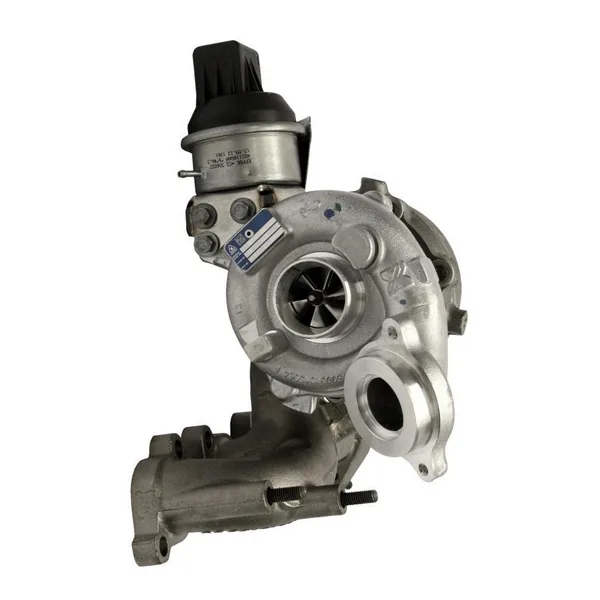
The 2.0 TDI 110 hp category groups turbocharger references built for one engine family shared across several vehicle generations. It serves the independent garage sourcing a part for a customer's car, the driver stranded with a loss of power or a limp-mode warning, and the home mechanic replacing a turbo without booking a workshop slot. Each reference here is tied to a specific mounting position and a documented compatibility range, so the starting point is always the vehicle, the engine code and the power figure, never a guess from a photo or a part number alone.
The range is built reference by reference, starting from the original turbocharger's mounting position and cross-checking engine codes, OEM equivalences and the variable-geometry mechanism fitted to each unit before a part is listed. A distributor sitting between the remanufacturer and the workshop plays a filtering role here: narrowing dozens of possible codes down to the ones that actually fit the 2.0 TDI 110 hp block, and keeping the standard exchange process, core returned, remanufactured unit shipped, straightforward for a single order or a recurring one.
Professional uses by trade
The same turbocharger reference is bought for different reasons depending on who is ordering it. A garage needs traceability and a fast turnaround, a stranded driver needs a clear match to their engine, a DIY enthusiast needs enough compatibility detail to avoid a return, and a German buyer needs that same clarity in their own language.
- Le garagiste independant: Confirms the exact turbocharger reference against the engine code and mounting position before ordering, avoiding a costly comeback for a mismatched part.
- L'automobiliste depanne: Matches a loss of power, a whistling noise or a limp-mode warning to a worn turbocharger before choosing a TDI 110 turbo replacement.
- Le passionne qui fait lui-meme: Cross-references the OEM part number and the engine code from home, then installs the standard exchange unit at their own pace.
- Der deutsche Kaeufer (DACH): Looks for the same reference in a language he can trust, then checks the engine code and years before ordering across the border.
- Le garagiste independant: Keeps the old core ready for the standard exchange, since a remanufactured turbocharger reference systematically requires the worn unit in return.
- L'automobiliste depanne: Checks whether the turbocharger, the injector or the high-pressure pump is behind a loss of power before ordering the wrong replacement part.
- Le passionne qui fait lui-meme: Learns the difference between a full turbocharger, a cartridge and a CHRA before choosing which level of replacement the car actually needs.
Range comparison
The table below lines up the two references carried in this 2.0 TDI 110 hp category, so a garage or a home mechanic can compare the exact use case and the exchange format before placing an order.
| Range | Use | Format |
|---|---|---|
| SL Turbo 5303 988 0205 | loss-of-power turbo replacement | |
| SL Turbo 5440 988 0036 | limp-mode turbo replacement |
How to choose
Choosing between two references in the same 2.0 TDI 110 hp family comes down to a handful of checks that avoid a comeback: engine code, mounting position, and what a remanufactured unit actually includes.
- Match the engine code stamped on the block against the reference sheet before ordering, since the same power figure can hide two different mountings.
- Check whether the listing covers a full turbocharger, a cartridge or a CHRA, because each level of replacement demands a different amount of work.
- Confirm the standard exchange terms, since the worn core has to be returned and a delay here can hold up the remanufactured unit shipment.
- Look at the coverage terms documented for each part, so the scope of what is and is not included is clear before installation begins.
- Verify the OEM equivalences listed against the vehicle's own documentation, particularly when the same 2.0 TDI 110 hp block was fitted across several models.
- Consider how the part will travel to a workshop or a driveway, since a turbocharger reference sitting in a rotating stock needs consistent packaging.
Storage & logistics
A turbocharger reference should stay in its original packaging until the moment of installation, with the inlet and outlet ports capped to keep dust and moisture out of the compressor and turbine housings. Stock rotation matters for a workshop carrying several 2.0 TDI 110 hp references at once: older units should move first, and the standard exchange core should be packed and labelled as soon as it comes off the vehicle, before oil residue or road grime makes the reference harder to identify on return.
Since 2026, our team has cross-checked engine codes and OEM equivalences on every 2.0 TDI 110 hp reference we list, favouring consistent quality checks over shortcuts on a part that a driver depends on daily.— autoKUR team
Related categories
Browse our other ranges:
Useful references
For regulatory and sector references, see Reglement (UE) 461/2010 — pieces de rechange et garantie constructeur.