
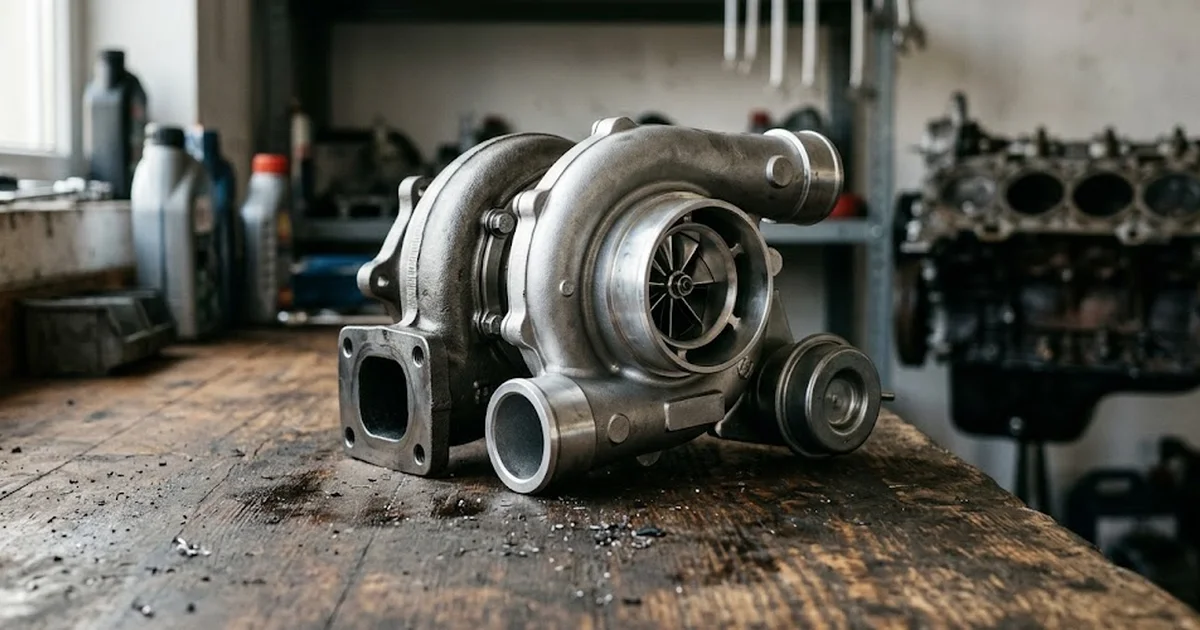
Car turbo price: the price range and what causes it to vary
Discover the average price of a car turbo, the differences between new, reconditioned, and used, and the factors that influence the final cost.
The turbocharger is now found on the vast majority of petrol and diesel engines, whether in city cars, saloons, or commercial vehicles. When this part shows signs of weakness or fails, one question always comes up: what budget should you plan for? The answer is never straightforward, as the price of a turbo depends on a multitude of technical and commercial factors. This article outlines the observed price ranges and the elements that explain these differences.
What is the average price of a car turbo?
Before going into the details of variations, it is useful to establish a general framework. The price of a turbocharger alone, excluding fitting, generally ranges from 200 to 1500 euros depending on the vehicle model, the brand of the part, and its condition (new, exchange standard, or reconditioned).
- Small petrol or diesel engines (city cars): between 200 and 500 euros for an exchange standard turbo.
- Saloons and compact diesel models: between 400 and 900 euros depending on the brand and the complexity of the turbo.
- High-end vehicles, large diesel engines, or bi-turbo engines: from 900 to 1500 euros, or even more for certain specific engines.
To these amounts, labour costs for fitting are generally added, which can represent an additional 150 to 400 euros depending on the accessibility of the turbo and the time required for the intervention.
What factors affect the price of a car turbo?
The final price of a turbocharger does not depend on a single criterion but on a combination of technical, commercial, and logistical factors. Understanding these factors helps anticipate the budget and avoid unpleasant surprises.
- The engine and displacement: the more powerful or complex the engine, the more technical and expensive the turbo is to produce.
- The vehicle brand: some premium brands use specific turbos, often more expensive than generic parts.
- The condition of the part: new, reconditioned, or used, each option has a direct impact on the price.
- The availability of the reference: a rare or low-production part leads to higher sourcing costs.
- The type of turbo: single turbo, bi-turbo, variable geometry, or twin-scroll, each technology has a different manufacturing cost.
- The supplier's origin: OEM part, recognised equipment manufacturer, or alternative supplier.
New, reconditioned, or used turbo: what are the price differences?
The choice between a new, reconditioned (exchange standard), or used part is often the factor that most strongly influences the final budget. Each option has advantages and limitations that should be understood before making a choice.
| Type of turbo | Indicative price range | Advantages | Points to watch |
|---|---|---|---|
| New (OEM or equivalent) | 500 to 1500 euros | Long warranty, maximum reliability | Highest market cost |
| Reconditioned / exchange standard | 250 to 800 euros | Good value for money, quality control performed | Requires returning the old turbo (deposit) |
| Used (scrapyard or spare part) | 100 to 400 euros | Lowest price | Uncertain lifespan, limited or no warranty |
Reconditioned, also known as exchange standard, is often seen as the best compromise between controlled cost and reliability, as the part has generally been tested before being put back on the market.
What is the total real cost, including labour?
The price of the turbo alone represents only part of the total bill. Labour, ancillary parts, and any additional diagnostics are added to the final budget.
- Initial diagnosis: often charged between 40 and 90 euros if not offered free of charge.
- Part price: variable according to the criteria mentioned above.
- Labour for removal and refitting: between 1 and 4 hours of work depending on engine accessibility.
- Recommended ancillary parts: hose, gasket, oil filter, sometimes a new oil feed kit.
- Post-fitting check: oil pressure check and road test.
Overall, a complete turbo replacement can cost between 500 and 2000 euros depending on the vehicle, the geographical region, and the professional chosen.
At autoKUR, we regularly observe that motorists compare only the price of the part without including labour or the ancillary parts essential for the proper functioning of the new turbo. Our recommendation is simple: always ask for a detailed overall quote, including the replacement of oil hoses where relevant, to avoid premature failure of the newly fitted turbo.
How to avoid paying too much for your car turbo?
Faced with sometimes significant price differences from one seller to another, several best practices help control your budget without sacrificing part quality.
- Compare several quotes, always specifying the exact reference of the vehicle (engine serial number, version, year).
- Favour reconditioned turbos offered with a written warranty, even a short one.
- Check if the seller uses a deposit system (taking back the old turbo), which can reduce the final price.
- Avoid used turbos without a history or prior inspection, as the risk of rapid failure is high.
- Plan the replacement as soon as the first signs of weakness appear (smoke, power loss, whistling noise) to avoid complete failure, which is often more costly.
Why do some turbos cost much more than others?
It is common to see price differences of several hundred euros between two vehicles of a similar range. This disparity is explained by precise technical reasons, often unknown to motorists.
- Turbine complexity: variable geometry turbos, which are more efficient, cost more to produce than fixed geometry models.
- Bi-turbo or tri-turbo systems: some recent engines use several combined turbos, which mechanically multiplies the replacement cost.
- Materials used: some high-end turbos incorporate materials that withstand higher temperatures and pressures.
- Low production volume of the reference: a model produced in small quantities is generally more expensive than a widely distributed reference.
These elements explain why it is essential to correctly identify the exact reference of the turbo corresponding to your vehicle before comparing prices, as two apparently identical vehicles may have different turbos depending on the version or year of manufacture.
Summary: what to remember about the price of a car turbo
The price of a car turbo varies significantly depending on the type of vehicle, the condition of the part (new, reconditioned, or used), the technical complexity of the turbo, and the supplier chosen. A reconditioned part with a warranty often remains the best compromise between controlled cost and reliability, provided the quality of the inspection carried out before sale is verified. The overall budget must also include labour and ancillary parts, often overlooked in quick comparisons. To find the reference suitable for your vehicle and compare the available options, you can consult the Turbocharger category, which lists the models corresponding to the different engines on the market.
You might also like
A question?
Get in touch directly.

Discussion
Our advice related to Turbocharger
 Turbocharger
Why Is My Turbo Whistling? Warning Signs and Causes
Is your turbo whistling under acceleration? Discover the differences between normal spooling and mechanical failure, from boost leaks to bearing play.
 Turbocharger
How Much HP Does a Turbo Add? Power Gains & Costs
Learn how much horsepower a turbo adds across engine sizes, what drives replacement costs, and how standard exchange delivers full factory performance.
 Turbocharger
Is a Turbo Covered Under Warranty? Coverage & Exclusions
Wondering if a turbo is covered under warranty? Learn what parts guarantees protect, common failure exclusions, and essential claim requirements to know.