

Available products
2 references

Frequently asked questions
About this category
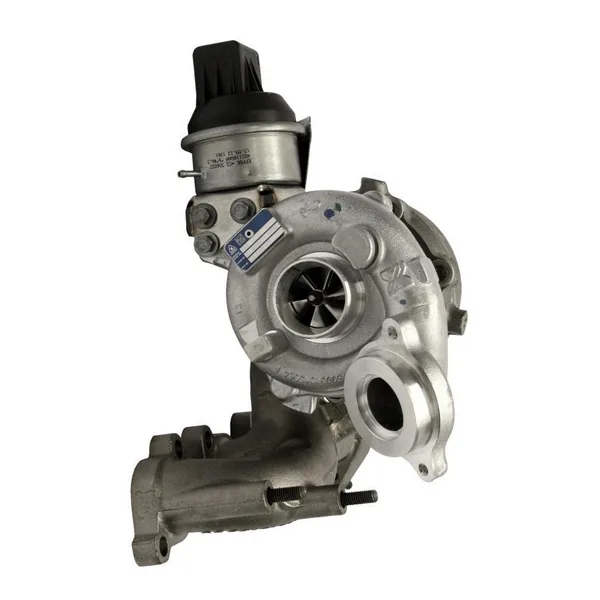
This category brings together the standard-exchange turbochargers matched to 2.0 TDI 140 hp engines, aimed at anyone who needs to replace a failing unit rather than research one from scratch. Independent garages use it to close out a repair order, motorists stranded by a sudden loss of power use it to find the part behind the symptom, and enthusiasts working on their own car use it to confirm a reference before buying. Every listing here corresponds to a documented turbo model, not a generic placeholder.
The range is built around exchange references rather than a broad catalogue: each unit here has a known part number, and the wholesaler's role is to keep that reference traceable from the moment it leaves stock to the moment the worn core comes back under the exchange scheme. That traceability is what lets a garage reorder the same part with confidence months later, and what lets a buyer trust a listing they cannot physically inspect before delivery.
Professional uses by trade
The same turbocharger reference serves different routines depending on who is ordering it. A garage treats it as one line in a repair job, a stranded driver treats it as the fix for a specific symptom, and an enthusiast treats it as a project component. The uses below reflect how each of these buyers actually approaches the listing.
- Independent mechanic: Confirms the exact turbo reference against the vehicle's engine code before ordering, so the exchange unit fits the repair job on the first attempt.
- Independent mechanic: Orders the standard-exchange unit alongside the worn core return, keeping the workshop's parts account balanced across several repair jobs each week.
- Independent mechanic: Checks the compatibility notes for the 2.0 TDI 140 hp engine family before quoting a customer, avoiding a returned part and a delayed repair.
- Independent mechanic: Keeps a short list of proven turbo references on hand so a diagnosis of lost boost pressure can move straight to ordering the part.
- Independent mechanic: Cross-references the OEM number stamped on the failed unit against the listing to make sure the replacement matches before removing the old turbo.
- Motorist facing a breakdown: Searches by engine code and horsepower after a mechanic diagnoses a failed turbocharger, trying to understand which part actually fits the car.
- Motorist facing a breakdown: Reads the compatibility details to confirm the listed turbo matches the vehicle before authorising a garage to order and fit the part.
- Motorist facing a breakdown: Looks for a standard-exchange option after losing power on the road, aiming to get the car moving again without buying a new unit.
Range comparison
The table below places the two references side by side so a buyer can move from diagnosis to order without opening a second tab. Each line matches a specific exchange unit, not a generic turbo, and the format column reflects how it ships.
| Range | Use | Format |
|---|---|---|
| SL Turbo 5440 988 0036 | replaces a failed turbocharger unit | |
| SL Turbo 5303 988 0205 | restores lost boost pressure |
How to choose
Choosing between two references comes down to matching the part number stamped on the failed unit, not guessing from the engine's horsepower alone. The criteria below help a buyer narrow the decision before placing a standard-exchange order.
- Match the exact reference stamped on the housing of the failed turbocharger before ordering, since visually similar units can carry different internal geometries.
- Confirm the vehicle's engine code against the compatibility notes rather than relying on horsepower alone, since several engine variants share the same power figure.
- Check that the core return process is understood before ordering, since the standard-exchange scheme requires the worn unit to be sent back afterward.
- Ask whether the variable geometry mechanism and actuator are included in the listed reference, since a mismatch here lets a mode dégradé symptom persist.
- Verify the cartridge or CHRA specification if only the internal turbine assembly needs replacing rather than the full turbocharger housing.
- Cross-check the OEM reference and known equivalences printed on the old part against the listing to rule out a near-identical but incompatible unit.
- Consider the warranty coverage attached to the reference before ordering, since exchange units differ in the terms applied after fitting.
Storage & logistics
A turbocharger unit waiting to be fitted should stay in its original packaging until the moment it is mounted, protecting the actuator and the variable geometry linkage from dust and impact during handling. Garages holding stock for several repair jobs benefit from keeping references separated and labelled, since two exchange units can look identical from the outside while covering different engine codes. The worn core awaiting return under the standard-exchange scheme should be kept dry and boxed separately, ready to ship back as soon as the replacement is confirmed fitted, closing out the exchange cycle cleanly.
Since 2026 our team has handled standard-exchange turbocharger orders daily, and what stays constant is the same habit: checking the reference against the failed part before it ships, not after a customer calls back.— autoKUR team
Related categories
Browse our other ranges:
Useful references
For regulatory and sector references, see Reglement (UE) 461/2010 — pieces de rechange et garantie constructeur.