


Frequently asked questions
About this category
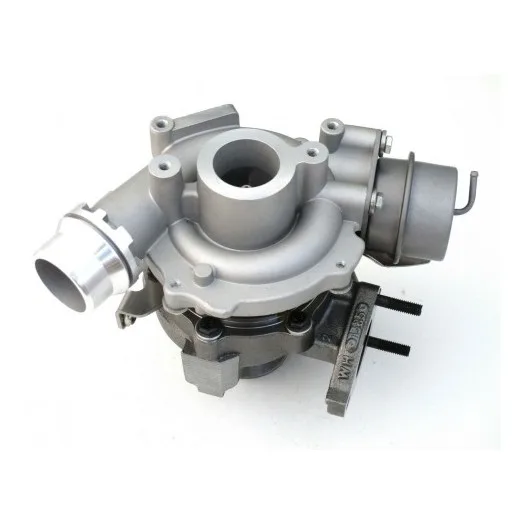
This category brings together exchange-standard turbochargers built for vehicles fitted with the 1.5 dCi 110 engine. It is designed for independent garages ordering a dci 110 turbocharger for a customer's vehicle, for drivers researching the part before a repair, and for hobbyists who prefer to handle the fitting themselves. Inside, references are organized by engine code, OEM number, and known equivalences, alongside the technical points that matter most when matching a turbocharger to a specific motorization: geometry type, cartridge configuration, and core exchange terms.
The range is built around the exchange-standard model: each dci 110 turbocharger is remanufactured from a returned core, tested against the original specification, and offered against the return of the failed unit through the core deposit arrangement. This structure keeps the reference list focused on parts with an established equivalence record for the 1.5 dCi 110 engine, rather than listing every possible variant regardless of documented compatibility.
Professional uses by trade
The reasons for consulting this category vary by who is searching. A garage technician, a driver managing a breakdown, a hands-on enthusiast, and a buyer in the DACH region each approach the same dci 110 turbocharger reference with a different starting point and a different question to answer.
- Le garagiste independant : Cross-references the engine code and OEM number before ordering a dci 110 turbocharger, so the reference matches the exact motorization on the lift.
- Le garagiste independant : Checks whether the customer's vehicle takes a cartridge-only CHRA or a complete turbocharger assembly, to plan the job and the parts order together.
- Le garagiste independant : Confirms the core exchange terms in advance, since the failed unit must be returned to close the consigned-core arrangement on the invoice.
- Le garagiste independant : Uses the reference list to identify equivalences across brands sharing the same 1.5 dCi 110 platform, saving time when a part number is unclear.
- Le garagiste independant : Keeps a short list of common failure symptoms, such as reduced power or a whistling noise, to explain the diagnosis to the vehicle owner before ordering.
- L'automobiliste depanne : Searches by vehicle, engine, and power output to find the dci 110 turbocharger matching a car that has suddenly lost power on the road.
- L'automobiliste depanne : Reads about common symptoms, such as smoke or limp mode, to understand what a professional is likely to diagnose before booking a repair.
- L'automobiliste depanne : Compares the exchange-standard option against a new part, since the core deposit and return of the old unit shape the total cost of the repair.
Range comparison
The table below lists the exchange-standard references available in this category, with the practical use each one serves and the general format in which it is supplied to garages and self-repairers ordering for the 1.5 dCi 110 engine.
| Range | Use | Format |
|---|---|---|
| SL Turbo 5438 988 0006 | turbocharger replacement | |
| SL Turbo 1635 970 0029 | turbocharger replacement |
How to choose
Choosing the right dci 110 turbocharger reference for the 1.5 dCi 110 engine comes down to a handful of checks that apply whether the part is ordered by a garage, a self-repairer, or a driver preparing for a professional's visit.
- Confirm the exact engine code and power output stamped on the vehicle's documentation, since several variants can share a similar external appearance on the same platform.
- Match the OEM reference or its listed equivalence before ordering, rather than relying on the vehicle model alone to identify the correct turbocharger.
- Check whether the application calls for a cartridge-only CHRA or a complete assembly, since the two options affect both the order and the job ahead.
- Review the core exchange terms in advance, since the failed unit must be returned to close the consigned-core arrangement tied to the order.
- Note the geometry type fitted to the engine, as variable geometry and fixed geometry units are not interchangeable across different power outputs.
- Keep the original part's markings on hand when ordering, so the reference can be cross-checked against the equivalence list before the part ships.
Storage & logistics
A remanufactured turbocharger should be kept in its original packaging until fitting, away from moisture and direct handling of the connection ports, to avoid contamination before installation. The failed core being returned under the exchange arrangement should be drained where applicable and packaged to prevent further damage in transit, since its condition on return is part of the consigned-core terms. Garages managing several open orders benefit from keeping each core paired with its corresponding invoice reference, so the exchange is closed correctly once the professional confirms the fitting is complete.
Since 2026, we have followed the 1.5 dCi 110 platform closely enough to keep our equivalence references accurate as new vehicle applications appear, so garages and self-repairers can order with confidence in the compatibility listed here.— autoKUR team
Related categories
Browse our other ranges:
Useful references
For regulatory and sector references, see Reglement (UE) 461/2010 — pieces de rechange et garantie constructeur.