

Available products
2 references

Frequently asked questions
About this category
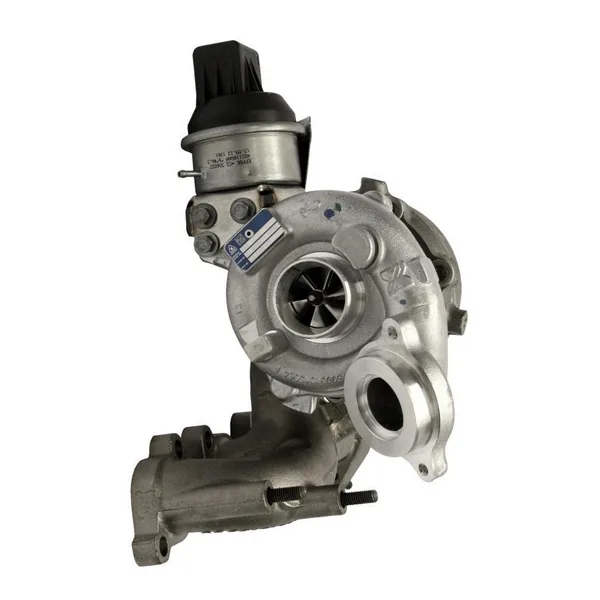
The 2.0 TDI 140 hp category gathers standard-exchange turbochargers built for vehicles fitted with this specific diesel engine and power output. Independent garages, drivers facing a sudden loss of power, and owners who prefer to handle their own mechanical work will find remanufactured units matched to the original engine code, alongside the OEM references and equivalences needed to confirm fitment before ordering. Each reference corresponds to a documented turbocharger design, spanning fixed and variable geometry cartridges, so the part ordered is the part the engine actually requires.
The range is built engine code by engine code rather than by vehicle model alone, since several manufacturers share the same 2.0 TDI 140 hp block across different badges. As wholesaler, our role is to hold the cross-reference between OEM part numbers, engine codes, and turbocharger geometry, so a garage or a workshop can order the correct standard-exchange unit once, with the core-deposit and return process for the worn part handled as part of the same order.
Professional uses by trade
A 2.0 TDI turbocharger exchange is approached differently depending on who is placing the order. An independent garage plans a workshop slot around parts availability, a driver reacts to a sudden fault, an enthusiast researches the repair before starting, and a German buyer expects the same technical rigor described in familiar terms.
- Le garagiste independant: Checks the engine code stamped on the failing turbocharger against the OEM reference before ordering the matching exchange unit for the workshop.
- Le garagiste independant: Plans the core-deposit return of the worn cartridge alongside the new standard-exchange turbocharger to keep the account balanced.
- L'automobiliste depanne: Recognises a loss of power, exhaust smoke, or a whistling noise as signs pointing toward the turbocharger rather than another engine fault.
- L'automobiliste depanne: Brings the vehicle to a workshop once the engine enters limp mode, so a professional can confirm the diagnosis before ordering the part.
- Le passionne qui fait lui-meme: Compares the OEM reference and engine code printed on the old part against the catalogue before choosing the exchange turbocharger.
- Le passionne qui fait lui-meme: Reads the failure symptoms — reduced boost, smoke, unusual noise — to judge whether the turbocharger or another component is at fault.
- Der deutsche Kaeufer (DACH): Expects the same engine-code cross-referencing and standard-exchange process described in familiar technical terms before placing an order.
Range comparison
The table below lists the standard-exchange turbocharger references available for the 2.0 TDI 140 hp engine, each supplied under the same core-deposit exchange principle and matched to a specific engine code and OEM equivalence.
| Range | Use | Format |
|---|---|---|
| SL Turbo 5303 988 0205 | engine code cross-reference match | |
| SL Turbo 5440 988 0036 | variable geometry cartridge replacement |
How to choose
Choosing between references for the same engine family comes down to a short list of checks a garage or an enthusiast can run before ordering, well ahead of any question of price or brand preference.
- Confirming the engine code stamped on the original turbocharger against the reference sheet before ordering, rather than relying on the vehicle model alone.
- Checking that the OEM part number and its listed equivalences match the failing unit, since several turbocharger designs can share a similar appearance.
- Verifying that the packaging protects the actuator and turbine housing during transport, since a damaged inlet or connector can delay a workshop repair.
- Storing the returned core unit under conditions that avoid corrosion of the flange and connectors before the exchange packaging is dispatched back.
- Expecting the same remanufacturing consistency from one exchange turbocharger to the next, so results with the engine remain predictable across replacements.
- Tracking how quickly a given reference turns over, since a fast-rotating exchange unit is more likely to be in stock when a garage needs it.
- Asking whether a defined warranty period accompanies the exchange unit, since coverage terms can differ from one reference to another.
Storage & logistics
Standard-exchange turbochargers for the 2.0 TDI 140 hp engine move through a two-way logistics flow: a replacement unit goes out to the garage or driver, and the worn core comes back under the same core-deposit principle, so storage space has to account for both directions at once. Units awaiting dispatch are kept boxed to protect the turbine housing, actuator, and connectors from dust and impact, while returned cores are set aside separately until the deposit is settled. A garage holding several references benefits from grouping stock by engine code rather than by vehicle brand, since that is how the parts are actually ordered and matched.
Since the range launched in 2026, our team has learned that most turbocharger returns trace back to a misread engine code, not a faulty part — which is why we check the code twice before any exchange unit leaves the warehouse.— autoKUR team
Related categories
Browse our other ranges:
Useful references
For regulatory and sector references, see Reglement (UE) 461/2010 — pieces de rechange et garantie constructeur.