


Frequently asked questions
About this category
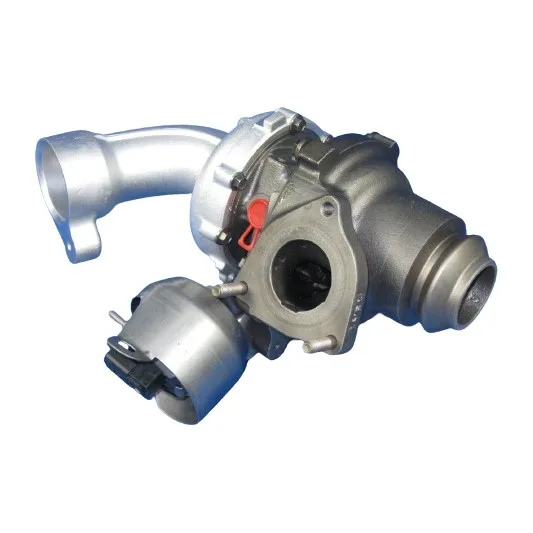
This category regroups the exchange turbochargers built for the 2.0 HDi 163 engine, a diesel block found across several manufacturer platforms sharing the same displacement and power output. It serves the driver stopped by a loss of power or a warning light, the independent garage diagnosing a whistling engine or exhaust smoke, and the home mechanic who already knows the engine code and wants the matching part rather than a generic listing. Because smoke and reduced power can also come from the fuel injection system, this listing covers the turbocharger itself, its cartridge and its variable geometry mechanism, not the surrounding injection components.
The range is built around the engine code first, then narrowed to the two exchange references currently available for the 2.0 HDi 163: a Garrett unit and an SL Turbo unit, both variable-geometry designs built around a CHRA suited to the same block. A wholesaler's role here is to keep both references traceable back to the original equipment specification, so a workshop ordering by engine code or OEM reference lands on a part that bolts on without adapting the manifold or the actuator linkage.
Professional uses by trade
A turbocharger reaches this listing through several different doors: the garage replacing a failed unit under time pressure, the stranded driver diagnosing a limp-mode warning, the enthusiast rebuilding an engine bay themselves, and the German buyer searching by engine code rather than by brand name. Each arrives with a different question.
- Independent garage: Diagnosing a loss of power or a persistent whistling noise on a 2.0 HDi 163 and confirming the failure sits in the turbocharger before ordering the exchange unit.
- Independent garage: Sourcing a reconditioned turbocharger by engine code when the vehicle's original reference is worn illegible or no longer listed by the manufacturer.
- Stranded motorist: Understanding why the engine has entered limp mode and a dashboard warning light appeared after a sudden loss of acceleration on the road.
- Home mechanic: Comparing the Garrett and SL Turbo references against the vehicle's engine code before removing the failed cartridge and variable geometry housing.
- Home mechanic: Checking the core deposit and return process for the worn turbocharger before starting the exchange to avoid an unexpected additional cost.
- German buyer (DACH): Searching by engine code and OEM equivalence rather than by brand name to confirm the reference fits the 2.0 HDi 163 block.
Range comparison
The two references available for the 2.0 HDi 163 are presented side by side below, each identified by its exact manufacturer designation so a buyer can cross-check against the vehicle's original part before ordering the exchange unit.
| Range | Use | Format |
|---|---|---|
| Turbo Garrett 806500-5001S | turbo replacement on 2.0 HDi 163 | |
| SL Turbo 806497-5001S | turbo replacement on 2.0 HDi 163 |
How to choose
Selecting between the two references comes down to a handful of practical checks that apply to any exchange turbocharger purchase, whether the order is placed by an individual mechanic or a workshop buying for stock.
- Confirming the engine code and OEM reference match before ordering, since a variable geometry housing built for a neighboring engine variant will not bolt on cleanly.
- Checking that the exchange unit ships as a single sealed reference rather than a bundle, so the core return process stays traceable to the correct part.
- Verifying the cartridge and actuator type specified for the reference, because the same engine code can carry more than one turbocharger generation across production years.
- Planning the core deposit return promptly after fitting the new unit, since the used turbocharger remains part of the exchange transaction until it is sent back.
- Asking whether the reference is currently in stock or on order, particularly when the vehicle is off the road and the repair timeline matters.
- Keeping the original packaging until the fitment is confirmed, in case the housing geometry or actuator linkage does not match the specific model year.
- Arranging for the unit to be fitted by a workshop or a qualified professional, since the exchange reference itself does not include installation.
Storage & logistics
A reconditioned turbocharger should stay in its original packaging until the moment of fitting, protecting the compressor wheel, the actuator and the variable geometry mechanism from dust and impact during handling. For a workshop holding several references in stock, keeping units grouped by engine code rather than by brand avoids picking the wrong housing under time pressure. The core deposit process adds a second logistics step: the worn turbocharger removed from the vehicle needs to be packaged and returned promptly, since it remains part of the exchange transaction rather than scrap to dispose of independently.
Since 2026, our team has focused the 2.0 HDi 163 turbo listing on exact engine-code matching rather than a broad brand catalogue, because a workshop under time pressure needs the right cartridge the first time, not a second delivery.— autoKUR team
Related categories
Browse our other ranges:
Useful references
For regulatory and sector references, see Reglement (UE) 461/2010 — pieces de rechange et garantie constructeur.