

Available products
3 references


Frequently asked questions
About this category
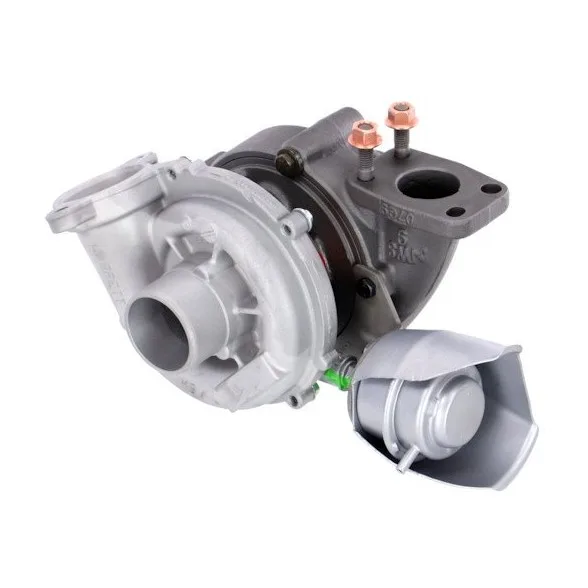
This category brings together exchange-standard turbochargers designed for 1.6-litre diesel engines rated around 90 hp, a configuration used across several European car and light-commercial platforms. Independent garages, workshop technicians, and drivers comfortable working on their own vehicle will find remanufactured units built to replace a failing turbo without waiting on a full rebuild. Each reference is selected for the cartridge geometry, actuator type, and mounting pattern specific to this engine family, so buyers can confirm fitment before committing to an order.
The range is built around cross-referenced OEM numbers rather than a single brand, so each turbocharger entry lists the equivalences a buyer needs to match cartridge, actuator, and flange to their specific engine code. As a wholesale supplier of exchange-standard parts, our role is to hold stock across these references, apply the core deposit process on returned units, and keep pricing structured for garages and resellers ordering on a recurring basis.
Professional uses by trade
A 1.6 TDCi 90 turbocharger is not used the same way by every buyer. The workshop diagnosing a fault, the driver stranded with a warning light, and the enthusiast planning a swap each approach the part from a different angle, so the usages below are grouped by who is actually placing the order.
- Independent garage: Cross-checks the OEM reference and cartridge geometry against the vehicle's engine code before ordering a 1.6 TDCi 90 turbocharger for a client's car.
- Independent garage: Keeps a small stock of exchange-standard turbochargers on hand to cut vehicle downtime when a customer reports a loss of power.
- Independent garage: Returns the worn cartridge under the core deposit process once the replacement turbocharger has been fitted and the vehicle has passed a road test.
- Independent garage: Compares actuator type and mounting flange across several equivalent references before choosing the part that matches the customer's exact vehicle without needing further adjustment.
- Independent garage: Plans replacement jobs around wholesale ordering cycles, grouping several 1.6 TDCi 90 turbocharger requests into a single delivery to control costs.
- Stranded driver: Notices a sudden loss of power, blue-grey smoke from the exhaust, or the engine dropping into limp mode and searches for the exact turbocharger reference.
- Stranded driver: Reads the vehicle registration document and engine code to confirm compatibility before contacting a workshop about a 1.6 TDCi 90 turbocharger replacement.
- Stranded driver: Chooses an exchange-standard part over a brand-new unit to get the vehicle back on the road within a workshop's usual scheduling window.
Range comparison
The table below lines up the three exchange-standard references carried for this engine family, so a buyer or workshop can check use case and wholesale format side by side before placing an order.
| Range | Use | Format |
|---|---|---|
| Turbo Garrett 753420-5006S | Garage restocking, direct fitment | |
| SL Turbo 5435 988 7000 | Multi-brand cross-reference sourcing | |
| SL Turbo 49173-07508 | Backup reference for availability |
How to choose
Choosing between exchange-standard turbochargers for the same engine family comes down to a handful of practical points a workshop checks before every order, from packaging to how quickly a reference turns over in stock.
- Packaging: Check that the turbocharger arrives individually boxed and protected against impact, since a damaged actuator or wastegate linkage can affect fitment on arrival.
- Storage: Keep the unit in its original packaging in a dry area until fitment, since exposed shaft seals and bearings are sensitive to dust and moisture.
- Consistency: Favour a reference with a stable cross-equivalence history, so repeat orders for the same engine code do not require re-checking fitment each time.
- Turnover: Pick a reference that moves regularly through the wholesaler's stock, since a fast-turning part is less likely to sit in storage for months.
- Core deposit: Confirm the return conditions for the worn cartridge before ordering, since the deposit is only released once the old part is received back.
- Cross-reference clarity: Verify that the OEM and manufacturer numbers listed for the part match the vehicle's registration document, not just a general engine name.
Storage & logistics
Exchange-standard turbochargers for this engine family are stored in their original protective packaging until the moment of fitment, keeping the compressor housing, actuator, and shaft seals shielded from dust and moisture. Workshops ordering in volume typically organise stock by OEM reference rather than by supplier brand, since several manufacturers can cover the same engine code. The core deposit process runs in parallel with storage: a worn cartridge collected during a job is logged and set aside separately, ready to be returned once the replacement unit is confirmed fitted, which keeps the wholesale account balanced for the next order.
We have supplied exchange-standard turbochargers for this engine family since 2026, and what stays consistent from one order to the next is the accuracy of the reference: a workshop should never have to guess whether a cartridge fits.— autoKUR team
Related categories
Browse our other ranges:
Useful references
For regulatory and sector references, see Reglement (UE) 461/2010 — pieces de rechange et garantie constructeur.